
Introduction
By July, across Cuming County, your corn has shifted gears. July corn fungicide timing becomes the single most important yield decision of the season. Fields are pushing tassels, silks are emerging, and what looked like potential in June is now being finalized. The crop is no longer building—it’s deciding. And that decision happens fast.
The challenge is that this is also when stress hits hardest. Heat, moisture swings, and disease pressure all converge at the exact moment yield is being set. Ohio State Extension research (2024) shows that interference during silking and early grain fill directly reduces kernel formation—meaning lost yield potential you can’t recover later.
Operations across Cuming County that consistently hit 220+ bushels per acre understand this shift. They don’t treat July like maintenance. They treat it like protection. They time fungicide applications precisely, layer in biostimulants like Yield On for tank-mix efficiency, and stay ahead of stress instead of reacting to it.
This is the most important stretch of the season. Because what happens now doesn’t just influence yield—it locks it in.
Why Reproductive Stages Matter Most
The transition from vegetative growth to reproductive stages is where yield potential becomes yield reality. Across Cuming County, this window—from tasseling (VT) through early grain fill (R3)—is when the crop determines kernel number and weight.
Iowa State Extension research (2025) shows that stress during pollination and early reproductive stages has the largest impact on final yield, even compared to earlier-season stress.
What Is Actually Being Determined?
At this stage, your crop is finalizing:
- Kernel number (set during pollination)
- Kernel retention (early grain fill)
- Kernel weight (through R3–R5)
Purdue University research confirms that severe stress during early grain fill can cause kernel abortion and reduced grain weight.
Cuming County consideration:
On Nora silt loam across Cuming County, high yield potential means more kernels are at risk if stress hits. On Moody complex ground, better moisture holding can buffer stress—but low spots may create oxygen stress after heavy rain. On Thurman-Blendon soils, stress shows up fastest due to limited water holding capacity.
How Fast Yield Can Be Lost
This isn’t gradual. It’s immediate.
On a 320-acre Cuming County operation:
- Pollination disruption: 15–30 bu/acre loss potential
- Early grain fill stress: 10–20 bu/acre
- Combined stress: 8,000–16,000 bushels at risk
That’s not theoretical—it’s happening in real time during July.
Why July Conditions Are So Risky
July stacks multiple stressors:
- Heat spikes reduce pollination success
- Moisture demand peaks
- Disease pressure accelerates
Each one alone is manageable. Together, they compound.
Timing Is Everything
Iowa State Extension research (2025) emphasizes that the impact of stress depends entirely on growth stage timing.
A stress event in June might cost you a few bushels. The same event in July? It can cost you 20+.
July Corn Fungicide Timing: Why This Is the Biggest Spray of the Year
If there’s one application that defines July, it’s the fungicide pass. Done right, it protects the bushels you’ve been building since May. Done wrong—or skipped—it leaves yield on the table.
Why Disease Threatens Yield Now
Disease pressure peaks during the hot, humid July weather that Cuming County experiences. Fungal pathogens like southern rust, tar spot, gray leaf spot, and northern corn leaf blight thrive in these conditions—and they’re already in your field whether you can see them or not.
The hidden timeline:
Disease spores are present in fields weeks before visible symptoms appear. By the time you can see lesions on upper leaves, the infection has been progressing for 19+ days. Treating after symptoms appear is treating an established infection. Treating before symptoms means you’re protecting the canopy that fills your ear.
Kaup’s July Fungicide Program
Veltyma (BASF) The Top-Tier Choice for Corn
Applied at VT/R1 (tasseling to silking) when corn is most vulnerable to disease impact on yield. BASF trials show an average 5.6 bu/A advantage over untreated corn—and that’s before factoring in Yield On tank-mix benefits.
Veltyma protects against gray leaf spot, tar spot, and northern corn leaf blight during ear fill—the period when disease directly steals bushels.
Delaro Complete (Bayer) Three Modes of Action
When resistance management matters or disease pressure is heavy, Delaro Complete delivers three modes of action (Groups 3, 7, and 11) in one product. The three chemistries attack disease organisms in different ways simultaneously—making it harder for disease to develop resistance.
Same timing as Veltyma (corn VT/R1, soybeans R3). Same application equipment. Works across both corn and soybeans—covering your whole operation in one program.
Product selection is season-dependent. Veltyma is Kaup’s top pick based on yield data, but Delaro Complete may be the better fit when disease pressure shifts or resistance management is a priority. Your Kaup agronomist will recommend what the season calls for.
Revytek for Soybeans at R3
Don’t forget your soybean acres. Revytek (BASF) is the standard for soybean fungicide protection, applied at R3 (beginning pod stage). BASF trials show up to 9.5 bu/A yield increase over other soybean fungicides.
Revytek controls white mold, frogeye leaf spot, and sudden death syndrome foliar symptoms during the pod fill window. Applied at 8 fl oz/A with non-ionic surfactant via ground sprayer—soybeans haven’t fully closed canopy at R3, so ground application still works.
Yield On: The Tank-Mix Multiplier
Here’s where the math gets interesting. Syngenta Biologicals’ Yield On is a biostimulant added directly to the fungicide tank Veltyma, Delaro Complete, or Revytek. Same tank, same pass, no extra equipment, no extra trip across the field.
What it does: Stimulates the plant to move more nitrogen, sugar, and micronutrients into the developing grain during fill.
What it delivers:
- Corn average: 4 bu/A
- Soybeans average: 1.5 bu/A
Yield On is never applied as a standalone it’s always part of the fungicide tank mix. The biostimulant benefit peaks at exactly the same reproductive growth stage as the fungicide window, making the combined pass the most efficient use of equipment and time.
The math on a 320-acre Cuming County corn operation:
- Veltyma protection: ~5.6 bu/A × 320 acres = 1,792 bushels
- Yield On in the tank: ~4 bu/A × 320 acres = 1,280 bushels
- Combined: 3,072 protected bushels
- At $4.50/bushel: $13,824 in additional value from one pass
You’re already paying for the application. Adding Yield On to the tank costs nothing extra in time, fuel, or trips—just more bushels at harvest.
Aerial Application: The Only Way to Reach Tall Corn
Once corn is fully tasseled, ground sprayers physically can’t move through 8-foot corn without breaking stalks. Damaging the plant at its most critical ear-filling moment defeats the purpose of the fungicide.
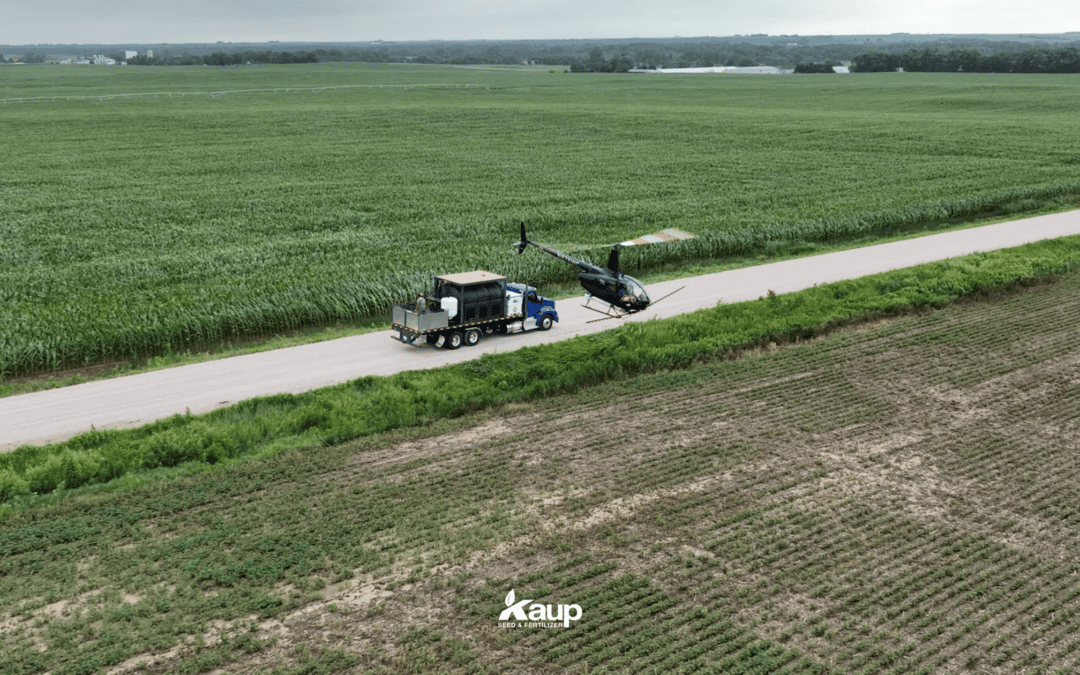
Kaup’s aerial application service (drone or fixed-wing aircraft) is built exactly for this window. Full top-down coverage on tall corn without crop damage. The only practical option for VT/R1 timing once canopy closes.
If you’re planning a fungicide application in July, the aerial spray slot needs to be booked—not assumed.
Recognizing Stress Signals Early
By the time stress is obvious from the road, yield is already lost. The key across Cuming County is recognizing early signals—before the crop shows irreversible damage.
Early Visual Indicators
Watch for:
- Leaf rolling by mid-morning (moisture stress)
- Delayed or uneven silking (pollination risk)
- Pale green upper canopy (nutrient limitation)
- Lesions on lower leaves (disease onset)
These signals often appear 48–72 hours before yield loss accelerates.
Cuming County consideration:
On Thurman-Blendon soils across Cuming County, leaf rolling shows up first—especially in sandier areas. On Moody complex fields, stress may appear as uneven color due to waterlogged pockets. On Nora silt loam, symptoms are more uniform but still time-sensitive.
Pollination-Specific Stress Signals
During R1 (silking), timing is everything.
Iowa State Extension research (2025) shows that each silk must be fertilized individually, and any disruption reduces kernel count.
Watch for:
- Silks emerging after pollen shed
- Drying silks during heat
- Gaps on developing ears
Even a short stress window can reduce kernel set.
Disease Pressure Signals
Southern rust, tar spot, and gray leaf spot often begin low in the canopy. UNL CropWatch research (2024) shows that severe infection reaching upper leaves during grain fill can reduce yields significantly.
Critical rule: If you can see disease lesions, the infection has been there for weeks. Visible symptoms mean fungicide is now treating established infection, not preventing it. The decision should be made before symptoms show.
Stress Progression Timeline
| Stage | Stress Signal | Yield Impact Timing |
| Early R1 | Delayed silks | Immediate kernel loss |
| R2 | Leaf stress | Kernel abortion risk |
| R3 | Disease spread | Reduced grain fill |
| R4+ | Canopy loss | Kernel weight reduction |
The Cost of Missing It
On 160 acres in Cuming County:
- Missed early stress detection: 10–15 bu/acre loss
- Delayed response: additional 5–10 bu/acre
- Total: 2,400–4,000 bushels gone
And once it’s gone—you can’t get it back.
Understanding the Silking Window
You’ve seen the stress signals. But to understand why silking stress is so expensive, you need to understand what’s actually happening inside the ear during R1—and why a 5-day window can cost 20+ bushels per acre.
One Silk. One Kernel. No Second Chances.
Purdue Agronomy research establishes the fundamental biology: every individual kernel on a corn ear has its own silk strand. Each silk must capture a pollen grain and be fertilized independently. There are no shortcuts and no redundancies.
A typical Cuming County ear develops up to 1,000 ovules, but only 400-600 make it to harvest as filled kernels. Every ovule that misses pollination is a kernel that doesn’t exist at harvest. It’s not smaller—it’s gone.
Silks begin elongating from the base of the ear approximately 10-14 days before R1 (roughly at V12), progressing toward the tip. The first silks to emerge are connected to the base kernels. The last silks to emerge—connected to the ear tip—are the most vulnerable. If pollen shed ends before tip silks emerge, those tip kernels are simply never formed. This is why you see “tip-back” (unfilled ear tips) in stress years.
Ohio State Extension (2024) confirms that silks remain receptive to pollen for at least five days after emerging. Miss that window—for any reason—and the kernel doesn’t form.
The ASI: Why Synchronization Is Everything
ASI stands for Anthesis-Silking Interval—the gap in days between when pollen sheds from the tassel (anthesis) and when silks emerge from the ear.
In a stress-free environment:
- Pollen shed and silk emergence happen nearly simultaneously (ASI of 0-2 days)
- Pollination window is maximized
- Kernel set is complete across the whole ear
Under heat or drought stress:
- Silk emergence is delayed (silks can’t elongate without adequate moisture)
- Pollen shed happens on schedule or earlier (tassel is less sensitive to stress than the ear)
- ASI stretches to 5, 7, or even 10+ days
- By the time silks emerge, pollen shed may already be finished
- Result: poor kernel set, barren ears, tip-back
Iowa State Extension research (2025) confirms that heat stress above 95°F desiccates silks before pollination can complete—even when pollen is present. Silks that dry out lose receptivity. A pollen grain landing on a dried silk doesn’t fertilize anything.
Modern hybrids have been specifically bred for shorter ASI. Some now silk slightly before pollen shed, which creates a buffer against stress-driven delays. This is one of the reasons hybrid selection matters beyond just yield data—stress tolerance at R1 is built into the genetics.
The Cuming County Soil Connection
Not all fields in Cuming County face equal ASI risk during a heat or dry stretch.
Thurman-Blendon sandy loams are most vulnerable. Low water-holding capacity means soil moisture deficits develop faster. A 5-7 day dry stretch during R1 on sandy ground can delay silk emergence enough to miss the pollen window—even if corn on heavier ground nearby pollinates cleanly.
Nora silt loam ground buffers better. The deeper moisture reserve keeps silk elongation on track through shorter stress periods.
Moody complex low spots can face a different problem: waterlogged pockets during wet years restrict root activity and oxygen availability at exactly the wrong time—limiting the plant’s ability to deliver energy to silk elongation and ear development.
This is why irrigation management during R1 on Thurman-Blendon ground is non-negotiable. Soil moisture below 50% during silking is a direct risk to kernel set.
How to Check Pollination Success: The Shake Test
Farm Progress (2025) documents the easiest field-level pollination check available: the shake test.
How to do it:
- Find an ear that silked 7-10 days ago (silks should be browning)
- Pull back the husk leaves
- Hold the ear horizontally
- Shake the ear firmly
What the results tell you:
- Fertilized silks fall off cleanly when shaken
- Unfertilized silks stay attached (still connected to an unfilled ovule)
- A clean ear after shaking = successful pollination
- Silks that won’t shake free = kernels that didn’t form
An alternative non-destructive method: observe for wilted, brown silks with reduced elasticity. These have been fertilized. Green, fresh-looking silks after pollen shed has ended = unfertilized = lost kernels.
Walk your fields 7-10 days after R1. If you’re seeing ears with large numbers of attached silks post-shake, your pollination success was compromised, and your yield forecast for that field needs to be adjusted.
The Pest That Specifically Targets Silk: Corn Rootworm Beetles
While heat and drought delay silk emergence, there’s a pest that actively destroys silks during the pollination window: **the adult corn rootworm beetle**.
Adult western and northern corn rootworm beetles emerge in early-to-mid July across Cuming County, and green silks are their primary food target. Scouting should prioritize fields with silking corn, as adult beetles are attracted to corn at this stage to feed on pollen and silk. They clip silks back to stubs—and a silk clipped before pollination is complete is a kernel that never forms.
The mechanism of damage is direct:
Adult corn rootworms feed on pollen and clip corn silks, sometimes interfering with pollination and leading to economic damage. If silks are clipped to less than ½ inch before pollination, the pollination can be incomplete.
This is especially significant because rootworm beetles are drawn to the earliest silking fields in an area. The earliest silking fields in an area often are most heavily damaged because beetles will move to them in search of green silks. Fields that tassel and silk ahead of neighbors become a congregation point for beetles from across the surrounding area—compounding silk pressure in your highest-potential fields first.
Japanese beetles are secondary silk clippers also active during R1. Japanese beetles are attracted to green silks and often mate and feed in clusters on plants. Unlike rootworm beetles, Japanese beetle feeding tends to concentrate on field edges first before moving inward.
Cuming County specific concern:
A recent study by UNL entomologists in northeast Nebraska found that Bt-resistant western corn rootworm populations immigrated into first-year maize fields from nearby continuous cornfields. Using weekly trap data and bioassays, researchers confirmed that first-year fields are no longer immune to rootworm pressure, especially when other infested fields are nearby. This is critical for Cuming County operations with any continuous corn acres nearby—rotation alone no longer guarantees protection.
Scouting protocol during silking:
Walk fields at R1 when silks are actively emerged and green. Check ear zone and full plant counts:
Corn rootworm threshold: 5 or more beetles per ear with silks clipped to less than ½ inch during active pollination (25-50% pollen shed) — treatment warranted
-Japanese beetle threshold: 3 or more beetles per ear with silks clipped to less than ½ inch and pollination less than 50% complete — treatment warranted
-After pollination is complete: Silk feeding no longer affects yield. Stop spraying.
The timing rule: Scouting should begin in early to mid-July and continue through August. But the treatment window is narrow—only while silks are green and pollen is actively shedding. Once pollination is complete and silks brown naturally, beetle feeding on remaining silk has zero yield impact.
The bigger picture: Even if beetle counts don’t hit treatment thresholds this year, heavy adult populations are laying eggs that will become next year’s larval problem. Document beetle counts by field now. Fields showing high adult pressure are candidates for rootworm management decisions in 2027 planning.
The Silking Window and Your Fungicide Decision
There’s a direct connection between silking success and your fungicide timing that most growers miss.
The plant needs maximum photosynthetic capacity during R1. Every leaf pulled out of production by disease—southern rust, tar spot, gray leaf spot—reduces the energy available for silk elongation, pollen viability, and fertilization. A plant fighting significant foliar disease during silking is a plant with a compromised R1 window.
This is the agronomic backbone behind the V10-V12 fungicide recommendation. Protecting the canopy before tassel means the plant arrives at silking with full photosynthetic capacity. Waiting until VT to apply fungicide means disease has already been competing for the plant’s energy during the most sensitive yield window of the season.
The silking window is 5 days per silk. The fungicide protection window is a week shorter than you think. Both windows close faster than most growers plan for.
Timing Decisions That Matter
Critical July timing windows:
Corn Fungicide: VT–R2
The 3-week sweet spot. Veltyma or Delaro Complete via ground sprayer at V10 (if early window) or aerial application at VT/R1. Add Yield On to the tank.
Soybean Fungicide: R3
Revytek or Delaro Complete with non-ionic surfactant via ground sprayer. Add Yield On to the tank.
Irrigation adjustments: Pre- and during silking. Maintain soil moisture above 50% available water through pollination.
Nutrient corrections: Before R2. After R2, response window closes.
Miss these windows, and effectiveness drops sharply.
Scouting vs. Reacting
Proactive management:
- Times fungicide before disease is visible
- Books aerial application before it’s needed
- Adds Yield On to the planned tank mix
- Protects yield
Reactive management:
- Sprays after symptoms appear
- Scrambles for aerial spots that are already full
- Misses tank-mix opportunities
- Higher bushel loss
Bushel Impact of Timing
On a 320-acre Cuming County farm:
- Timely fungicide (Veltyma + Yield On): +9–12 bu/acre = 2,880–3,840 bushels
- Proper irrigation timing: +10–20 bu/acre = 3,200–6,400 bushels
- Total protection: 6,000–10,000+ bushels
Timing isn’t a detail. It’s the driver.
Balancing Protection with Efficiency
Protecting yield doesn’t mean overapplying inputs. It means applying the right inputs at the right time.
Where Overapplication Happens
Common mistakes:
- Blanket fungicide without considering soil-type variability
- Overwatering early, under-watering at peak
- Late nitrogen that isn’t utilized (and after V8, isn’t even practical)
Efficiency matters just as much as protection.
Matching Inputs to Soil Type
| Soil Type | Risk Level | Best Strategy |
| Moody complex | Moderate | Monitor moisture + disease in low spots |
| Nora silt loam | High reward | Full protection at key stages |
| Thurman-Blendon | High risk | Frequent, smaller interventions |
Cuming County consideration:
On Nora silt loam, full-season protection often pays because of yield ceiling. On Moody complex, variability requires selective management. On Thurman-Blendon, efficiency is critical—overapplication leads to loss, not gain.
The Efficiency Mindset
Instead of asking:
- “Should I apply?”
Ask:
- “Will this protect yield right now?”
The Veltyma + Yield On tank-mix at VT/R1 isn’t just a fungicide application—it’s a 9-12 bushel decision per acre. The cost of skipping it on 320 acres is roughly $13,000-$17,000 in protected yield.
Targeting High-Return Windows
The best return comes from:
- Pollination window (R1)
- Early grain fill (R2–R3)
Outside those windows, returns diminish.
Avoiding Wasted Passes
Every pass should:
- Address a real risk
- Be timed correctly
- Deliver measurable yield protection
The beauty of Yield On in the fungicide tank: you’re not adding a pass you’re maximizing the pass you’re already making.
Avoiding Late Reactions
The biggest mistake in July isn’t doing the wrong thing it’s doing the right thing too late.
Why Late Reactions Fail
By R3:
- Kernel number is already set
- Aborted kernels are gone
- Stress effects are locked in
Ohio State Extension research (2024) shows that while later stress affects kernel weight, earlier stress determines kernel number—which has a larger yield impact.
Common Late-Season Mistakes
- Applying fungicide after disease reaches upper canopy
- Increasing irrigation after pollination stress
- Attempting late nutrient rescue
- Trying to book aerial spray slots after they’re full
These actions feel productive—but deliver limited return.
The Illusion of Recovery
Corn doesn’t “bounce back” the way you think. It compensates:
- Smaller kernels
- Fewer kernels
- Reduced ear size
Bushel Reality
On 160 acres in Cuming County:
- Early intervention (Veltyma + Yield On at VT/R1): protects 15–25 bu/acre
- Late intervention (after symptoms): recovers 2–5 bu/acre
- Difference: 2,000–3,200 bushels
That’s the cost of waiting.
The Right Approach
- Anticipate stress
- Book aerial application early
- Plan Yield On into the tank mix
- Monitor continuously
Cuming County consideration:
Fields on Moody complex ground may look fine longer—but once stress appears, it’s already advanced. On Thurman-Blendon soils, delay is even more costly due to rapid stress progression. On Nora silt loam, high yield potential amplifies the cost of late decisions.
Conclusion
July is when Cuming County corn moves from potential to performance. VT through R3 is a narrow window—often just 2–3 weeks—where kernel number, retention, and early grain fill are determined.
The crop isn’t asking. It’s deciding.
If disease is managed early with Veltyma or Delaro Complete, the canopy stays productive. If Yield On is in the tank, the plant moves more energy into the developing grain. If aerial application is booked before tassel, the timing is precise. If scouting catches stress before it spreads, problems stay small.
And if any of those aren’t there? The crop doesn’t wait. It adjusts.
Fewer kernels. Lighter ears. Reduced yield. All showing up at harvest, long after the July decisions that caused them.
The operations across Cuming County consistently hitting 220+ bushels aren’t reacting in July. They’re anticipating. They’re protecting. They’re managing stress before it becomes yield loss.
July is about protection. Because once yield is lost now—it’s gone for good.
Not sure if your fields are protected during pollination and early grain fill?
July moves fast. Disease establishes 19 days before you see it. Aerial application slots fill up. The difference between proactive and reactive management shows up in thousands of bushels by harvest.
Whether it’s confirming your fungicide product choice between Veltyma and Delaro Complete, booking the aerial application slot, or planning the Yield On tank-mix that protects an extra 4 bushels per acre, we’ve worked across Cuming County to know what effective July management looks like.
Explore your acres’ potential.