
Feeding the Crop: V8-V14 Nutrient and Water Management in Cuming County Corn
Introduction
By early June across Cuming County, your corn isn’t just growing—it’s exploding. V8-V14 nutrient management is the most critical window of the entire season, and the crop won’t wait. This represents the most aggressive vegetative growth period of the entire season. The same plant that took 45 days to reach knee-high will hit shoulder-height in the next 14 days.
And the crop is hungry.
Bayer research shows that corn takes up more than half its total nitrogen supply between V8 and tasseling (VT)—a period that may comprise only 30 days. That’s not a gradual increase. That’s a nutritional sprint.
The operations across Cuming County that consistently hit 220+ bushels don’t just deliver nitrogen. They deliver it when the crop can actually use it. They monitor moisture when daily water use jumps from 0.15 inches to 0.30+ inches per day. They scout for disease before lower leaf lesions move to ear leaves. And they understand that June isn’t about reacting to problems—it’s about feeding momentum.
Because the crop moving from V8 to VT isn’t asking for nutrition. It’s demanding it.
Kaup’s Plant Nutrients and Nutrient Efficiency programs are built around matching inputs to exactly this window.
V8-V14 Nutrient Management: Feeding Rapid Growth
The V8-VT Nitrogen Window
Between V8 (eight leaf collars visible) and VT (tassel emergence), corn transitions from building vegetative structure to determining yield components. Bayer research documents the uptake timeline:
V6-V12: 25% of total N uptake
V12-VT: Additional 40% of total N uptake
V8-VT combined: More than 50% of seasonal nitrogen demand in 25-35 days
This isn’t theoretical. On a 220 bu/acre Cuming County field:
- Total N requirement: ~175 lbs N/acre (0.8 lbs N/bu)
- V8-VT uptake: ~90-100 lbs N/acre
- Daily demand at V12-V14: 3-4 lbs N/acre/day
The timing challenge:
If nitrogen isn’t plant-available when demand peaks, the crop starts cannibalizing itself. Leaves yellow. Stalk reserves get mobilized. Ear shoots abort. And you can’t fix it later—those lost kernel rows at V8-V10 aren’t coming back.
Why Sidedress Timing Matters
Pre-plant N alone: Works on heavier Nora and Moody soils with good organic matter and moisture retention. On lighter Thurman-Blendon soils with low water-holding capacity and spring rainfall, you’re gambling on how much nitrogen stays put until V10—leaching risk is high.
Split applications: On irrigated Nora targeting 220+ bushels, pre-plant 100-120 lbs N + sidedress 60-80 lbs N at V6-V8 matches uptake timing better than 175 lbs up front.
Products like NutriSphere-N from Kaup’s Nutrient Efficiency lineup help protect that nitrogen investment by reducing leaching and volatilization losses.
Why the V6-V8 window:
- Root system established and actively exploring soil volume
- Crop hasn’t yet entered peak demand (you’re front-running the need)
- Equipment can still travel between rows without leaf damage or ear burn
- After V8, corn canopy affects spreader pattern and can burn developing ears
Nitrogen Loss Mechanisms in Cuming County
Leaching (coarse-textured soils):
Thurman-Blendon sandy loams around Bancroft: 2+ inches of rain in 48 hours can move nitrate below root zone. UNL research shows sandy soils lose 20-30% of applied N in wet springs.
Denitrification (fine-textured, poorly drained areas):
Heavy spots in Moody complex fields: saturated soil for 3-5 days creates anaerobic conditions. Nitrate converts to nitrogen gas. You don’t get it back. Losses can hit 30-50 lbs N/acre in ponded areas.
Sulfur: The Overlooked Co-Limitation
Corn needs 15-25 lbs S/acre for 200+ bushel yields. Continuous corn on Nora and Moody soils with low sulfate-S levels commonly show deficiency by V8-V10.
- How to diagnose sulfur vs. nitrogen deficiency:
- Sulfur: Yellowing/interveinal striping on newest leaves (upper canopy) first
- Nitrogen: Yellowing begins on oldest leaves (firing from the bottom) and moves up
- Critical distinction: Sulfur is immobile in the plant. Nitrogen is mobile.
- Cuming County sulfur considerations:
- Continuous corn removes more S annually than corn-soy rotation
- High-residue no-till ties up S in decomposition (temporarily unavailable)
- Low organic matter hilltops often sulfur-deficient first
- Irrigation water rarely supplies meaningful S (unlike some chloride or sodium)
If deficiency appears at V8-V10:
At this stage, foliar sulfur applications are your only option—ground-applied sulfate products would require driving through tall corn and cause more damage than the deficiency itself. Work with your agronomist on foliar sulfur options, though response will be slower than earlier applications. The better approach: soil test for sulfur and apply with pre-plant or starter fertilizer to avoid late-season deficiency.
Water Demand and Irrigation Management
Daily Water Use Through Growth Stages
Corn water demand isn’t linear. It ramps hard.
- V4-V8:
- 0.10-0.15 inches/day
- Root system still expanding
- Canopy small, soil evaporation dominates
- V8-V12:
- 0.15-0.25 inches/day
- Rapid leaf area expansion
- Transpiration begins dominating over soil evaporation
- V12-VT:
- 0.25-0.35 inches/day
- Full canopy established
- Peak vegetative demand
Research from Bayer CropScience shows that corn enters its most water-sensitive period at V12-V14, when daily use peaks and any stress begins affecting ear size determination.
On a 160-acre irrigated Nora field:
At V12, the crop is pulling 40-56 acre-inches per day across the field. That’s 1.1-1.5 million gallons daily. If available soil moisture drops below 50% and the forecast shows no rain for 5+ days, you’re already in a deficit.
Soil Moisture Monitoring
Don’t guess. Measure.
Cuming County growers using soil moisture probes report 15-25% water savings compared to calendar-based scheduling, with equal or better yields. Michigan State University research confirms that real-time moisture data prevents both under- and over-irrigation.
Kaup offers a full Moisture Probe service through CropX, including installation, in-season monitoring, and irrigation recommendations tailored to your soil type.
What to monitor:
- Soil moisture at 12″, 24″, 36″ depths
- Check daily during V10-R2 (critical window)
- Trigger irrigation when available water drops to 50% in the top 24″ of root zone
Cuming County soil-specific thresholds:
- Nora silt loam (1.8-2.0″ water per foot):
- High water-holding capacity
- Can go 4-5 days between irrigations at V12
- Risk: Over-irrigation creates shallow rooting
- Moody complex (1.5-1.8″ water per foot, variable):
- Moderate capacity, but clay lenses complicate movement
- Watch for perched water tables in heavy areas
- May need zone management within fields
- Thurman-Blendon sandy loam (0.8-1.2″ water per foot):
- Low water-holding capacity
- May need irrigation every 2-3 days at peak demand
- High leaching risk—watch N management
When to Start Irrigation
Traditional rule: Start when soil moisture hits 50% depletion in root zone.
Better rule for Cuming County: Start irrigation by V10 on sandy soils and V12 on silt loams, even if soil moisture is adequate, to establish consistent moisture and prevent stress as demand ramps.
Why front-run the need:
Once corn shows visual stress (leaf rolling, gray-green color), you’ve already lost 3-5% yield. University of Nebraska research shows that maintaining moisture above 50% available water through V12-VT protects kernel row determination.
Cuming County growers on pivots:
Run 0.75-1.0 inches every 4-5 days starting at V10 (sandy soils) or V12 (silt loams), increasing frequency (not necessarily volume) as demand peaks at V14-VT. In extreme heat (95-100°F weeks), you may need to shorten intervals to every 3-4 days. Adjust based on rainfall and soil moisture readings—don’t over-irrigate just because it’s hot.
Dryland management:
If you’re dryland on Nora or better Moody ground, you’re betting on subsoil moisture and timely June rain. Watch forecasts. If the 10-day outlook shows no significant rain and soil moisture is declining, start planning for reduced yield targets and adjust late-season input decisions accordingly (fungicide ROI drops if yield ceiling is already cut).
Disease Scouting and Early Detection
Why V8-V12 Matters for Disease Management
Most foliar diseases (gray leaf spot, northern corn leaf blight, southern rust, tar spot) establish on lower leaves during vegetative growth and move upward. By the time you see lesions on ear leaves at VT-R1, the infection has been present for 2-3 weeks.
The V8-V12 scouting window allows you to:
- Identify which diseases are present and active
- Assess hybrid susceptibility in your specific field environment
- Determine if conditions favor disease progression
- Decide if early fungicide application (V10-V12) is warranted for top-tier products like Veltyma
- Plan whether additional VT-R1 application will be needed
Fungicide timing strategy:
Top-tier fungicides (Veltyma, Delaro complete) often perform best at V10-V12, especially for southern rust and tar spot. If disease is present at V8-V10 and conditions favor spread, application at V10 protects developing ears and upper canopy. VT-R1 timing is a backup or secondary application, not the primary window.
Key Diseases to Scout in Cuming County
Southern Rust:
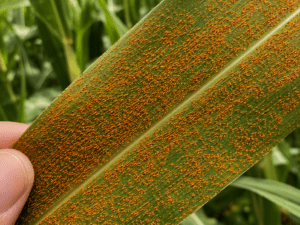
The primary yield-limiting disease in Cuming County over the past four years. Small orange-to-tan pustules on upper and lower leaf surfaces. Spreads rapidly in warm (75-85°F), humid conditions. Unlike other diseases, southern rust can appear suddenly and progress quickly—fields can go from clean to severe infection in 7-10 days.
What to look for at V8-V12:
- Orange pustules (raised bumps) on leaf surface
- Can appear on both upper and lower leaves simultaneously
- Spreads from lower canopy upward when established
- Most aggressive in hot, humid weather
Southern rust has been persistent in northeast Nebraska for four consecutive years and should be your primary scouting focus.
Tarspot
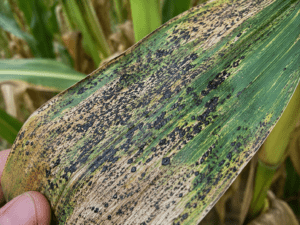
Increasing concern in Cuming County. Small, raised black spots (stromata) on leaves. Favored by moderate temperatures (60-70°F) and extended periods of high humidity or leaf wetness.
What to look for:
- Tiny black spots, often with yellow halos (fisheye lesions)
- Usually appears mid-to-late season but scouting starts early
- Can cause significant yield loss if conditions favor development
- More common in river-bottom ground with poor air movement
Gray Leaf Spot (GLS)
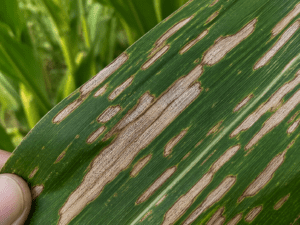
Less problematic than it was 10-15 years ago due to improved hybrid resistance. Rectangular lesions with parallel edges (following leaf veins). Still worth scouting, especially in continuous corn with heavy residue, but modern hybrids handle this better than southern rust or tar spot.
Northern Corn Leaf Blight (NCLB):
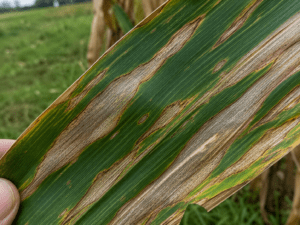
Long, cigar-shaped tan lesions. Starts on lower leaves and moves up. Favored by moderate temperatures (64-81°F) and extended leaf wetness. Less problematic than southern rust or tar spot in recent years, but still worth monitoring.
Eyespot:
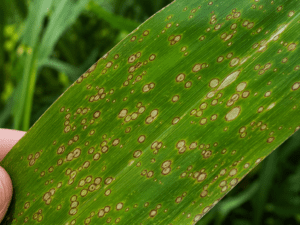
Small circular lesions with yellow halos. Not typically yield-limiting unless severe. Increasing in no-till systems but remains a secondary concern compared to southern rust and tar spot.
Scouting Protocol
Frequency:
Walk fields weekly from V8 through VT. Focus on:
- Low-lying areas (higher humidity, longer dew periods)
- Areas with poor air movement
- Field edges near trees or shelterbelts
- Continuous corn fields with heavy residue
What to assess:
- Which diseases are present?
- Are conditions favorable for spread? (Hot + humid = southern rust/tar spot active; cool + wet = NCLB/GLS active)
- What’s the forecast? (One set of pathogens thrives in heat, the other in cooler temps—if it’s growing season, something is always active)
Disease action threshold:
The Cuming County reality: If it’s hot and humid, half the fungal pathogens are active. If it’s cool and wet, the other half are active. Between V8 and VT, conditions almost always favor something.
Practical rule: If you see disease establishing at V8-V10—even at low levels—treat it. Once visible, the plant is already infected. Waiting to see if it “gets worse” just means you’re treating an established infection instead of a developing one.
When fields are clean (rare):
If you scout V8-V10 and see no disease—truly clean lower leaves, favorable hybrid resistance, good air movement—you can monitor through V12-V14. But clean fields in Cuming County are the exception, not the rule, especially in continuous corn or high-residue systems.
The decision point:
If you’re seeing moderate disease pressure at V10-V12, and the forecast shows continued wet/humid conditions, plan for fungicide application at VT-R1. Don’t wait to scout at tassel—by then the window for maximum protection is narrowing.
Fungicide Application Strategy
The decision point:
If you see disease at V8-V10, application at V10-V12 with top-tier products (Veltyma, Delaro Complete) provides best protection for southern rust and tar spot. Don’t wait for VT-R1—by then, infection is established in the canopy.
Scenario 1: Disease visible at V8-V10, any severity
→ Apply fungicide at V10-V12. Conditions are favorable (it’s June in Nebraska), and visible disease means infection is present.
Scenario 2: Fields scouted clean at V8-V10 (rare)
→ Continue monitoring through V12-V14. If disease appears, treat immediately. If fields stay clean through V14, you may skip fungicide—but this is uncommon in Cuming County.
Scenario 3: Heavy disease progression V8-V12, rapid spread
→ Apply at V10, plan for second application at VT-R1 if pressure continues and conditions remain favorable.
Economic reality:
Fungicide costs $40+ per acre (product + application). At $4.50/bushel corn, you need 9-10 bushels to break even. Crop Protection Network data shows fungicide applications where disease is present average 8-15 bushel protection. The ROI is there when disease is active—and in Cuming County June conditions, disease is almost always active.
Kaup’s fungicide program recommendation:
For maximum protection, start with Affiance at V5 it provides good early coverage, but the residual doesn’t extend through the critical VT window. Follow with Veltyma or Delaro Complete at V10-VT to protect developing ears and upper canopy through pollination. This two-application approach provides season-long disease suppression when conditions warrant.
Growth Stage-Specific Management Recommendations
V8-V10 Management
Nitrogen:
- Sidedress window has closed (should have been done V6-V8)
- Evaluate crop color and lower leaf health
- If yellowing present (N deficiency), foliar N may provide limited rescue—consult agronomist
Water:
- Sandy soils: Begin irrigation if soil moisture dropping below 60%
- Silt loams: Monitor but likely not critical yet unless unusually dry
Disease:
- Continue weekly scouting of lower leaves
- Note which diseases are establishing
- If disease is visible, plan V10-V12 fungicide application
Stand assessment (if not done at V4-V5):
- Final plant population count
- Check for variability within field
- Too late to replant—focus on managing what you have
V10-V12 Management
Nitrogen:
- Crop in rapid uptake phase
- Too late for ground-applied sidedress (corn too tall, would damage ears)
- If deficiency visible, limited rescue options—focus on prevention next year
Water:
- Daily water use increasing to 0.20-0.30 inches
- Irrigated ground: Regular watering schedule established
- Dryland: Watch 7-10 day forecast closely
- Soil moisture probes showing significant value here
Disease:
- Critical fungicide decision window
- If disease present at V10, apply fungicide immediately (Veltyma, Miravis Neo)
- Don’t wait for VT-R1—treat visible disease now
Weed management:
- Last practical window for POST herbicide in most crops
- Weeds taller than corn at this point are yield thieves—economics of control declining
V12-V14 Management
Nitrogen:
- Peak uptake period
- Crop using 3-4 lbs N/acre/day
- Deficiency symptoms now translate directly to ear size reduction
- If chlorosis appears, it’s too late for rescue—manage for next year
Water:
- Peak vegetative demand
- Irrigated: 0.75-1.0 inches every 4-5 days (adjust frequency in extreme heat)
- Dryland: This is where subsoil moisture determines ceiling
- Leaf rolling in afternoon = stress signal (yield loss already starting)
Disease:
- If fungicide not yet applied and disease present, apply immediately
- V10-V12 is optimal window for top-tier products
- Waiting until VT means treating established infection, not preventing it
Growth monitoring:
- Stalk diameter increasing
- Ear shoots developing (V12-V14)
- This is when kernel row number is being set (14-18 rows typical for Cuming County hybrids)
Economics of V8-V14 Management
What Aggressive Feeding Is Worth
On 160 acres of irrigated Nora targeting 220 bu/acre:
Scenario 1: Optimized V8-VT management
- Split N application (V8-V10 sidedress)
- Proactive irrigation starting V10
- Disease scouting guiding VT fungicide decision
- Result: 220 bu/acre achieved
- Total production: 35,200 bushels
Scenario 2: Passive management (pre-plant N only, reactive irrigation, no scouting)
- Nitrogen timing mismatch (some loss, some late availability)
- Irrigation starts after visual stress
- Fungicide decision made without intel
- Result: 200 bu/acre (9% loss from sub-optimal nutrition + moisture stress + disease)
- Total production: 32,000 bushels
Loss: 3,200 bushels = $14,400 at $4.50/bushel
What it costs to manage V8-VT aggressively:
- Sidedress application: $12-18/acre (custom application)
- Irrigation electricity/fuel: $40-60/acre (season total, but V8-VT is peak use)
- Weekly scouting time: Minimal cost (grower time), massive ROI
Investment: ~$8,000-12,000 additional on 160 acres
Return: $14,400 protected yield
Net: $2,400-6,400 gain from better V8-VT management
Where Growers Lose Yield in June
#1: Waiting too long to sidedress
Sidedressing at V8-V10 is too late—corn canopy affects spreader pattern and can burn developing ears. The window is V6-V8, period.
#2: Assuming soil moisture is fine without measuring
By the time leaves roll, you’ve lost yield. Soil moisture probes are $800-1,500/field and pay for themselves in 1-2 years via water savings + maintained yield.
#3: Waiting to see if disease “gets worse” before treating
If you see disease at V10, the plant is already infected. Treating immediately (V10-V12) protects yield. Waiting until VT means treating established infection—less effective, more expensive in lost bushels.
#4: Treating all 320 acres the same
Your Nora ground and your Thurman-Blendon ground don’t have the same water-holding capacity or nitrogen needs. Manage by soil type, not by whole-farm averages.
Practical Field Protocols for June
Weekly V8-V14 Checklist
Nitrogen status:
- Walk fields, check lower leaf color
- Look for V-shaped chlorosis starting at leaf tips (N deficiency)
- If present and widespread: Sidedress immediately
Water status:
- Check soil moisture (probes or feel test at 12″ depth)
- Assess crop color in afternoon (dark green = adequate, gray-green = stress starting)
- Check leaf rolling at 2-4 PM on warm days (rolling = stress)
Disease presence:
- Scout lower 4-6 leaves on 20-30 plants per field
- Identify disease types present
- Estimate % leaf area affected
- Note if moving up canopy
Weather forecast:
- Check 7-10 day outlook
- Rain in forecast? (Reduces irrigation needs, favors disease)
- Hot and dry? (Increases water demand, reduces disease)
Soil Type-Specific V8-V14 Strategies
Nora silt loam (prime ground, 220+ bushel target):
- Sidedress 60-80 lbs N at V6-V8 (total season: 175-190 lbs N)
- Start irrigation by V12 if no rain in 7-day forecast
- Scout disease weekly—if visible at V10, apply fungicide immediately
- Maintain soil moisture above 50% available water through VT
Moody complex (variable ground, 190-210 bushel target):
- Sidedress 50-70 lbs N at V6-V8 (total season: 150-170 lbs N)
- Irrigation timing varies by zone—heavier areas may not need it; lighter areas critical
- Disease scouting important—treat if present
- Consider variable-rate irrigation if equipment allows
Thurman-Blendon sandy loam (lighter ground, 170-190 bushel target):
- Sidedress 40-60 lbs N at V6-V8, consider split if leaching risk high (total season: 135-150 lbs N)
- Start irrigation by V10—low water-holding capacity makes this critical
- Frequent irrigation (every 3-4 days) beats infrequent heavy
- Disease typically less problematic (faster drying), but treat if visible
Conclusion
The V8-V14 window is where 220-bushel corn separates from 190-bushel corn. Not because of seed cost. Not because of land quality. Because of management intensity during the 21 days when the crop is building the factory that will make the grain.
Nitrogen that isn’t available when the crop is pulling 3-4 lbs/day? You can’t make it up later. Water stress when daily use hits 0.30 inches? Those ear shoots are already being determined. Disease establishing on lower leaves at V10 that you don’t treat immediately? It’s already in the ear leaves by the time you wait for VT.
The operations across Cuming County hitting 220+ bushels aren’t doing more things. They’re doing the right things at the right time.
They sidedress at V6-V8 before the crop enters peak demand. They measure soil moisture instead of guessing. They treat disease when it’s visible at V10, not when it’s severe at VT.
That’s not intensive management. That’s just paying attention when it matters.
Not sure if your nitrogen timing, irrigation schedule, or disease pressure justifies action?
V8-V14 moves fast. You’ve got 21 days to feed the crop properly, keep moisture adequate, and scout for disease before decisions get expensive.
Need help dialing in sidedress rates for your soil types? Want to talk through fungicide ROI based on what you’re seeing in fields? Looking for soil moisture probe recommendations?
Talk to a local expert today.