
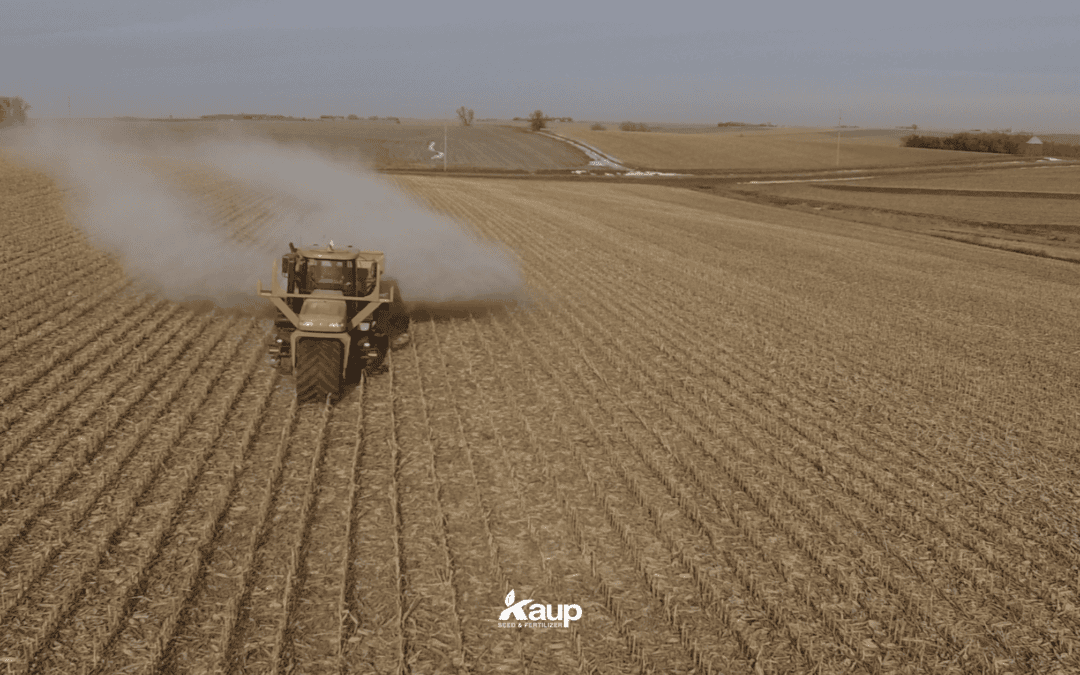
Fall Fertility Application: Your Last Window Before Freeze
Here is a question we field every fall. “My pH came back at 6.2. That is fine, right?”
It is not a crisis. Nobody would call 6.2 sour ground. But Kaup targets 6.7 to 6.8 for corn, and the gap between those two numbers is bushels you paid for and did not get. Every pound of phosphorus going on that field is working at less than full strength, and it will keep working at less than full strength until the pH comes up.
That is the thing most lime conversations miss. Lime is not a rescue for ground that has gone bad. It is what makes every other input on the farm perform.
Fall fertility application is how that gets fixed, and the window is closing. Not on a date somebody circled on a calendar. Lime will not go on frozen or snow-covered ground, because it runs off with the melt instead of working into the soil. Gypsum, phosphorus, and potassium are the same story. When the ground closes, the work stops, and what you meant to correct this fall becomes something you correct next fall.
November is the last month that reliably cooperates.
Lime: Rate, Timing, and Why the Four-Year Cycle
You already know what lime does. The open questions are how much, when, and whether there is a truck available.
Why November and Not March
Lime does not act on contact. It has to dissolve and react before pH moves at all, and that takes three to six months.
Count backward from planting. Lime on the ground in November has the winter to work and shows up in next spring’s crop. Lime applied in March does not. It is still useful, but it is fixing the crop after next, not the one you are about to plant.
The hard stop is physical rather than agronomic. Lime cannot go on frozen or snow-covered ground. It sits on the surface and leaves with the runoff when the snow melts. You paid for a product that ended up in the ditch.
That is why the window here is October and November, not “sometime over winter.”
Kaup Applies a Big Rate Every Four Years
This is where our approach differs from what you will read in a lot of general guidance, and the reasoning is economic rather than agronomic.
Kaup puts on a substantial rate roughly every four years instead of a light rate annually. Low rates every year mean paying for a spreader pass, a truck, and the trip every single season to move pH a little. The application cost does not shrink just because the rate does. Four years of those passes cost real money and accomplish what one properly sized application would have.
The rate itself comes off a soil test, not off habit. There is no standard number, because the number depends on your buffer pH, your soil, and how far you are from target.
Product Quality Is Not Uniform
Two lime products at the same rate per acre can deliver noticeably different results. Neutralizing value depends on both the material’s calcium carbonate equivalent and how finely it is ground, because finer particles expose more surface area and react faster.
This matters when you are comparing a price per ton. A cheaper ton that neutralizes less acidity is not cheaper. It is a different product.
Surface Application in No-Till
Lime that is not worked into the soil moves downward slowly. It still works, but the timeline stretches, which makes November timing more important on no-till ground rather than less.
If that is your situation, the rate conversation is different too, and it is worth having with your Kaup agronomist rather than assuming a tillage rate transfers.
Gypsum: A Separate Pass, and a Number to Look For
Gypsum goes on in the same months as lime and it is a different decision entirely. These are two passes, not one. Both can happen in the same season, but they are separate applications and they are not interchangeable.
Gypsum adds calcium and sulfur, and it improves soil structure and water infiltration. UNL Extension (2023) notes that gypsum is an excellent source of sulfate sulfur, which is the form the crop can actually take up.
Two Things Point to It
Structure. Heavy clay and compaction-prone ground. If roots are not exploring the profile the way they should, structure is a limiting factor and gypsum addresses it directly. This is the case most growers already recognize.
Magnesium balance, and this is the precise one. Where magnesium base saturation is at or above 15 percent, Kaup recommends gypsum at 1.5 ton per acre to flush the excess magnesium out and restore balance.
That second trigger is the one worth asking about. It comes straight off a soil test you may already have in hand, and most growers have never been shown that line on the report.
Magnesium is rarely short in Nebraska soils. The problem here is the opposite one. It sits on the exchange sites in proportions that work against structure, and against the availability of other nutrients.
Gypsum also plays into phosphorus and aluminum tie-up. That is the subject of the next section, and the reason these two decisions get made together even though the passes do not.
What It Is Not
Gypsum is not a substitute for lime and lime is not a substitute for gypsum. They are driven by different numbers on the same report. A field can need both, one, or neither, and the soil test is what tells you which.
Phosphorus and Potassium, and the Part Already in Your Soil
Dry granular phosphorus and potassium go on broadcast across the field surface. Both have minimal movement in the soil, so they mostly stay where they are placed. Fall application gives them the winter to settle into the root zone, and it keeps them out of the spring equipment queue when there is no room for one more pass.
Same constraints as everything else here. October and November, not on frozen ground, rate from a soil test.
Removal figures by crop and yield level are on Kaup’s crop nutrient removal rate table, which is the faster way to run your own numbers than working from a general figure.
Where to Spend First When the Budget Is Tight
Input costs are running above the past two crop years. Terrain (2026) projects operating costs up 4 percent for corn and 6 percent for soybeans against the prior year, which makes the order you spend in matter more than usual.
For Nebraska ground specifically, UNL (2023) puts nitrogen as the nutrient most likely to be deficient. Phosphorus comes next.
Potassium, sulfur, zinc, and iron are generally adequate in most Nebraska soils. Apply those where a soil test or a visible deficiency says to, not as a default across every acre.
That is a different priority order than you will find in guidance written for states east of here. It is also the one that fits your fields.
Placement is the other lever. UNL notes that banding phosphorus is efficient enough to use roughly half the broadcast rate for the same effect. If budget is the constraint, placement buys you more than cutting the rate does.
Only About a Quarter of Your Applied Phosphorus Is Reachable
That is the number that reframes this whole section.
Phosphorus bonds with calcium, magnesium, aluminum, and iron within days of hitting the soil and converts into forms the plant cannot use. The fertilizer did its job. Soil chemistry took most of it before the crop got a turn. Years of applications have left a reserve down there that you have already paid for and cannot currently reach.
Phree-uP works on both ends of that at once.
The first half is Verdesian’s XCHAIN technology. It is a high-charge exchange resin that attracts calcium, magnesium, aluminum, and iron, so they cannot fix the phosphorus you are applying now.
The second half is a biostimulant. It raises native microbial activity in the soil, specifically acid phosphatase enzyme activity. That is the enzyme that mineralizes phosphorus held in soil reserves and returns it to a plant-available form.
Protecting the new, recovering the old. Verdesian reports an 85 percent win rate across field trials, with gains up to 4.7 bushels per acre.
Kaup also runs its own Innovation Platform trials before recommending anything. When you want to know whether a product works here, that beats a manufacturer’s data sheet.
The Pattern That Points to It
Soil test says phosphorus is adequate. The crop still responds when you give it more.
That is tie-up, not shortage, and it is the exact problem this product is built for.
It is also the only phosphorus efficiency product in the line that does anything useful on a field getting no phosphorus at all. The reserve is already there to be unlocked.
Kaup mixes it into the spreader load with fall phosphorus in October and November. The label allows pre-plant, at-plant, and in-season timing too, so missing the fall pass does not cost you the product. What it costs is the winter head start on freeing what is already bound.
Turning the Report Into a Prescription
A soil test tells you the state of the field. It does not tell you what to do about it, in what order, or at what rate on which acres.
Why the Same Number Means Different Things
Phosphorus at 14 ppm calls for a different rate on 220 bushel Nora silt loam than on 180 bushel Thurman-Blendon. Same value on the report, different decision, because the yield the ground is capable of changes what it takes to get there.
TrueRec is Kaup’s own fertility recommendation program and a registered trademark. It layers soil type, nutrient balance, yield goals, and environmental conditions into a field-specific plan. That is not something a competitor matches by stocking the same products.
Where the Maps Come In
If parts of a field underperform year after year, that is a pattern worth mapping rather than averaging away. Profit Zone is Kaup’s precision package. It covers grid soil sampling and analysis, variable rate prescriptions for lime, gypsum, phosphorus, potassium, and nitrogen, variable rate seeding prescriptions, and harvest yield maps.
Four map types come out of it. A harvest map, a pH and fertility map, a soil map, and a seeding map. The data is accessible from any device without calling in.
A low-yielding zone with adequate fertility is a physical problem. Drainage, compaction, water. A low-yielding zone with low pH is a chemical problem, and the cheaper of the two to fix.
You cannot tell those apart from the yield map alone. You cannot tell them apart from the soil test alone either.
Why This Conversation Happens Now
Agronomy consulting runs heaviest November through February, and that is not an accident of the calendar. Your yield data is fresh, you still remember which fields disappointed you and why, and nothing is being decided under time pressure yet.
By March the decisions are being made against a planting date. In November they are being made against the data. Those produce different programs.
Your Seed Decision Is Really a Herbicide Decision
Seed has been available since September, which makes this the one item on the list you could already have handled.
Wyffels for corn, Stine for soybeans in either Enlist E3 or XtendFlex. There are cash and volume discounts on seed, worth asking about when you place the order.
The reason to get to it rather than let it ride is that the trait you buy decides next summer’s chemistry.
Your post-emergence options next summer are set by the trait you buy now. The weed problem you had this year gets solved at the seed order or it does not get solved at all. Work that through while this year’s escapes are still fresh, not in the last ten minutes of an ordering call.
Allocation is the other reason. Once a hybrid runs short and goes on allocation, a late order may not get filled at any price.
Fertilizer Prices Run on Their Own Calendar, Not Yours
This part of fall fertility application has nothing to do with your ground.
Fertilizer is not behaving like most years. Nitrogen, sulfur and phosphorus are all volatile in world trade right now, and that volatility has producers and ag retail locking in pieces of 2027’s needs earlier than anyone would normally bother. When the supply side starts buying ahead of itself, that is worth noticing.
What it asks of you is vigilance in planning rather than panic. Know where your break evens need to sit before you commit to anything.
What Is Driving It
The Strait of Hormuz is the short answer, and the three nutrients are not behaving the same way.
IFPRI (2026) tracked the first half of the year. Global nitrogen exports fell about 9 percent against the same period in 2025, with Saudi Arabian exports down 63 percent and Qatar’s down 37 percent. Phosphate ran a similar shape, exports off more than 9 percent, with MAP and DAP prices up 25 to 30 percent after the closure and holding there since mid-May.
Sulfur is the one nobody was watching. Prices have more than doubled since the start of the year, and elemental sulfur exports fell 33 percent in the first half, with shipments from several Gulf exporters cut by more than half.
Nitrogen, meanwhile, spiked and then came back. Prices ran well above January levels through the spring and had largely retraced by the end of August.
That last part is what makes this a planning problem rather than a price problem. This is not a market that is simply expensive. It is a market where three nutrients you buy in the same season are moving in three different directions, which is why last year’s assumptions will not carry.
Worth noting if gypsum is on your list this fall, since sulfate sulfur is half of what it supplies. A chokepoint on the other side of the world does not feel like a northeast Nebraska problem until it turns up on that line of your plan.
There is relief coming on the domestic side. In October 2026, USDA put 573 million dollars of grant money into eight new domestic fertilizer projects covering nitrogen, phosphorus, potassium and sulfur, roughly 1.08 million tons of annual capacity, with more than 1.34 billion dollars of total investment behind it.
The catch is the calendar. USDA’s own projections apply once those projects are running, and no completion dates have been published. Plants take time to build.
None of that capacity helps you in the 2027 growing year. So 2027 gets planned against the market as it is, not the one being built.
Pre-pay opens December 1 and this year’s terms come out with it. There is nothing to commit to yet, which is exactly why November is when to work the numbers.
The Fall Window, and What Happens After It
DTN (2026) has tracked retail fertilizer prices weekly since 2008. The seasonal pattern in that data is consistent, and it does not follow the farm calendar.
Nitrogen is at its cheapest in late summer and early fall. Since 2020, August has been the cheapest month for anhydrous ammonia. From there it climbs through October and into December. Liquid nitrogen runs a similar shape, usually cheapest in September.
Most expensive in May.
That is the whole argument in two lines. May is when a spring program needs the product. May is historically when it costs the most. Every month you move the decision earlier is a month further from that peak.
Product Timing and What Is Left to Choose From
This is the one growers underrate, and it is not about price at all.
A product on allocation does not become available because you are willing to pay more for it. When supply tightens heading into spring, early commitments get filled first and late ones get substituted. The selection narrows as the window closes, so a late order is choosing from what is left rather than from what the field actually called for.
Delivery timing works the same way. Confirming when product arrives, not just that you have it coming, is part of the conversation.
The Workload Argument
Buying ahead spreads this across fall and winter instead of stacking it into March.
The planning is fall work. Pull your soil results, set rates field by field, total your volume. The commitment is winter work, once terms are out. Splitting it that way means neither half lands in the same week as planting prep, equipment, and whatever the weather is doing.
Every decision settled by January is one not competing for attention in March.
Volatility, Which Is the Real Case
Fertilizer markets move on natural gas prices, trade policy, and global supply disruptions. None of those follow your crop calendar, and winter is historically a volatile stretch.
Locking a plan early protects it from a last-minute swing. That is a different thing from predicting the market, and it is the more useful one.
What This Does and Does Not Do
What it does: turns an unknown into a known. In a year where operating costs are already projected higher, a fertility budget that cannot move on you is worth something real on its own.
What it does not do: guarantee you called the bottom. Nobody times that, and the value here is certainty rather than a winning trade.
What to Bring to the December Conversation
Your volume, worked out from this year’s soil tests. Not last year’s order. The whole point of testing was to change the number.
Last spring’s invoice. When terms come out, the comparison that matters is what you paid in spring against what is in front of you. Have the number ready rather than reconstructing it.
A question about the cost of money. Kaup finances pre-pay in house rather than sending you to your operating line, which makes this a cost-of-money question as much as a price question. The rate comes with the December terms.
Seed is a separate conversation with its own cash and volume discounts, as above. Those are not fertilizer pre-pay and they do not run on the same clock.
Your Fall Fertility Application, In Order
- Sit down with your results. Field by field, not farm average.
- Check pH first. Acidic soil locks up nutrients regardless of what rate you apply. If pH is the problem, nothing downstream works until it is fixed.
- Decide lime off the soil test. Big rate, four-year cycle. On the ground before it freezes or snows.
- Check magnesium base saturation. At or above 15 percent, gypsum at 1.5 ton per acre, as its own pass.
- Set phosphorus and potassium. Rate from the test, placement as the lever if budget is tight.
- Decide on phosphorus protection. Phree-uP in the spreader load if tie-up is the pattern.
- Start the seed and herbicide conversation. Thinking now, ordering in December.
- Review your fertility plan and total your volume. Then confirm timing and delivery with your advisor, so the December 1 decision takes ten minutes.
The first six have the same deadline, and it is in the forecast rather than on your calendar. The last two have a date.
Conclusion
A soil test is only worth what you do with it, and right now what you can do with it has a shelf life measured in weeks.
Lime needs three to six months in the ground before pH moves, which means November lime is next spring’s crop and March lime is not. Gypsum, phosphorus, and potassium all stop when the ground does. The phosphorus already locked in your soil stays locked unless something goes out there to free it.
None of that is urgent because we said so. It is urgent because the ground freezes, and it does not check whether you got to your soil test first.
Behind the field work sits the other half of the plan. Fertilizer is cheapest in late summer and early fall and most expensive in May, and the pre-pay decision arrives December 1. The work that makes that decision easy, pulling your results and totaling your volume, is November work too.
If your pH came back at 6.2 and you were planning to think about it over the winter, this is the month both of those decisions actually get made.
Call to Action
Have your results and not sure what they are telling you?
Reading the categories is the easy part. The rest is where a conversation earns its keep.
Matching rates to what each soil type can actually produce. Sizing a lime application you will not have to repeat in two years. Catching a magnesium number most reports never get read for. Deciding where phosphorus protection pays. Totaling the volume that plan adds up to, so the December buying decision is arithmetic rather than a guess.
We have worked ground across Cuming, Dodge, Colfax, Stanton, Burt, Thurston, and Wayne counties long enough to know what those numbers mean on your fields. There is still time this month to act on them.
Talk to a local expert today.