
Kick Back the Residue: They’re Already Germinating
Walk out to a field that came off last week and kick back the residue. Fall weed control starts with what you find under there.
You are probably looking at bare ground and stalks. But underneath, marestail rosettes are the size of a dime. Henbit is putting out its first square stems. Field pennycress is sitting flat against the soil where nothing can see it.
They will sit there all winter. They will start growing again in March. And by the time you are ready to plant in early May, they will be big, tough, and expensive to kill.
Most growers never see this. Harvest is running, the days are short, and nobody is walking fields looking for weeds that are barely an inch tall. So the problem stays invisible until spring, when it shows up as a burndown that did not work and a planter running through a green mat.
The growers across Cuming County and the neighboring northeast Nebraska counties who have the cleanest fields in May are not lucky. They made a pass in the fall.
What Is Actually Germinating Right Now
Winter annual weeds run on a different calendar than everything else in your field. They emerge in late summer and fall, survive the winter as small plants, then produce seed in late spring or early summer the following year.
UNL CropWatch identifies the winter annuals that matter most across Nebraska: marestail, henbit, field pennycress, prickly lettuce, shepherd’s purse, downy brome, tansy mustard, and dandelion.
Three of those deserve your attention first.
Marestail
This is the one that will cost you the most money.
Most marestail across eastern Nebraska is resistant to glyphosate and to the ALS group of herbicides. UNL Extension (2025) is blunt about what that means in the field: glyphosate will not help you. A glyphosate burndown in April will not touch it. Growers who find that out in the spring are already behind.
Marestail is also the hardest to spot. In the fall it is a small rosette pressed flat against the ground, and in a no-till field the residue hides it completely. You have to move the trash to find it.
It has one more trick. Unlike most winter annuals, marestail keeps germinating into the spring and even after planting. That is why a fall pass with residual activity matters more on marestail than on anything else in the field.
Henbit
Henbit is easier to kill but faster to reproduce.
Henbit moves from flowering to viable seed fast enough that plants can be flowering and shedding seed at the same time. If you wait until you can clearly see henbit from the pickup, the seed for next year is already going into the ground.
Henbit also carries a second problem that has nothing to do with weed competition. More on that below.
Field Pennycress
Pennycress grows low and flat through the fall and winter, then bolts fast in early spring. It is a mustard, and like the rest of the mustards it gets tough quickly once it starts to stretch.
It also hosts soybean cyst nematode.
Why These Weeds Are Cheaper to Kill in the Fall
There are four reasons the fall pass works better than the spring pass. Two of them are about the weed. Two of them are about your calendar.
Small Weeds Die Easier
This is the simple one. Younger weeds are more susceptible to herbicide than older weeds.
A marestail rosette in October is a target. The same plant in late April is a bolting stem with a waxy surface and a deep root. You are spraying the same acre either way, but one of those applications works and one of them fights you.
The same logic runs through the whole list. Ohio’s Country Journal (2025) notes that a fall burndown targets winter annuals and perennials when they are most susceptible, and that these species become difficult to control in the spring once they have overwintered.
They Are Stealing Nitrogen and Moisture
Winter annuals are not dormant. They are growing, and they are pulling from the same soil your next crop will use.
Every pound of nitrogen a winter annual takes up over the winter is a pound your next crop does not get. It does not come back when the weed dies in June. It went into weed biomass.
Moisture matters even more this year. After a dry season across most of Nebraska, subsoil recharge over the winter is what dryland acres are counting on. Every winter annual growing through March and April is drinking from that reserve before your corn ever gets a root down.
Farm Progress (2024) notes that fall burndown helps maintain soil moisture specifically in drought-stressed conditions. In a normal year that is a minor benefit. This year it is not.
The Spring Weather Window Is Not Reliable
Everyone plans a spring burndown. Not everyone gets one.
Spring weather in northeast Nebraska does what it wants. A wet April compresses everything into the same two weeks, and when the ground finally dries, planting wins the argument over spraying. The burndown gets rushed, gets tank mixed with something it should not be, or gets skipped.
The fall window has less competing for it. Fields are coming open, the sprayer is available, and there is no planter waiting on you.
Cleaner Fields Plant Better
A field that goes into winter clean warms and dries faster in the spring. That is especially true in no-till, where a mat of green residue holds cold and moisture right where the seed needs to go.
Farm Progress (2024) reports that the net effect is more uniform crop emergence with fewer stresses working against the stand.
The Soybean Cyst Nematode Connection
This is the part most growers do not know, and it may be the strongest argument on the list.
Henbit and field pennycress are alternative hosts for soybean cyst nematode.
Michigan State Extension (2024) confirms that soybean cyst nematode survives on winter annual weed species including henbit, and SDSU Extension (2025) recommends controlling them for that reason.
What that means in practice: a field full of henbit and pennycress over the winter is a field where SCN populations keep building during the months you assumed they were dormant. Researchers call it a green bridge. The weed carries the pest from one crop to the next.
The stakes are real. Crop Protection Network (2025) data shows soybean cyst nematode caused more estimated yield loss than any other soybean disease in the northern states in 2024. Yield losses of up to 30 percent have been documented in fields showing no visible symptoms at all.
Iowa State Extension (2026) recommends a timely fall herbicide application in fields that had significant henbit infestations, and pairing it with fall soil sampling to check SCN egg populations before the next soybean crop.
If you are rotating to soybeans next year and you have had henbit pressure, this is not a weed control decision. It is a nematode decision.
Which Fields Earn a Fall Weed Control Pass
Fall weed control does not need to cover every acre. It needs to cover the right acres.
Strong candidates:
- Fields where the spring burndown did not work last year
- No-till and reduced-till ground, which consistently carries heavier winter annual populations
- Any field with known marestail pressure, especially glyphosate-resistant marestail
- Fields going to soybeans next year that had henbit or pennycress
- Fields that came off early, giving weeds a longer fall window to establish
- Ground with a history of soybean cyst nematode
Lower priority:
- Fields that were clean at harvest with no visible winter annual emergence
- Ground going into a cover crop that will suppress winter annuals on its own
- Fields harvested very late, where cold has already stalled weed growth
The way to sort your acres is to walk them. Move the residue in a few spots per field and see what is actually there. What you find in October tells you what you would have fought in April.
One planning note on rotation. Nebraska restricts fall application of atrazine and atrazine-containing products in certain rotations. Confirm the current rules for your specific rotation with your agronomist before building a fall program.
How the Application Window Works Around Harvest
The fall window is real but it is not long, and it is governed by the weed rather than the calendar.
When to Apply
UNL research reported by Farm Progress (2023) found most fall emergence was complete by early November, which makes late October through mid November the target window for the main application in a typical year.
The reason to wait that long is coverage. Spraying in early October catches what has emerged so far and misses everything that comes up afterward. Waiting until emergence is largely finished means one pass covers the whole flush.
The reason not to wait longer is temperature.
The Temperature Limit
Foliar herbicides need the plant to be actively growing. The chemistry has to move inside the plant to work.
Once cold stalls growth, uptake drops and control drops with it. The practical rule is that the plants need to be green, healthy, and actively growing when you spray. A hard freeze followed by cold days does not necessarily kill the weed, but it can shut down the plant enough that a spray no longer does much.
That is what makes the window narrow. You are waiting for emergence to finish while racing the first sustained cold.
Building the Program
Two principles matter more than any specific product.
Do not rely on glyphosate alone. With most Nebraska marestail resistant to both glyphosate and ALS chemistry, a glyphosate-only fall pass leaves the hardest weed in the field standing. GROW IWM (2025) recommends a burndown program with two or more effective modes of action plus effective residuals for glyphosate and ALS-resistant marestail. The second mode of action is what makes the application work, and it also slows resistance from developing in the rest of the winter annual population.
Add residual where marestail is the target. Because marestail keeps germinating into spring, a burndown with soil residual activity holds ground that a contact-only application gives back.
The specific chemistry depends on your rotation, your resistance history, and what next spring’s program looks like. That is a conversation to have with your Kaup agronomist rather than a decision to make off a general recommendation.
Worth confirming this season. Product availability in the burndown category has shifted recently, including changes affecting some long-standing options. Confirm what is available before you build the program around a specific product.
Book the Pass Before the Post-Harvest Rush
Here is the part that decides whether any of this actually happens on your ground.
The fall application window is short, and every grower in the county wants it at the same time. When harvest wraps, the phone starts ringing and the calendar fills within days.
The growers who get sprayed at the right time are the ones who called before harvest finished, not after.
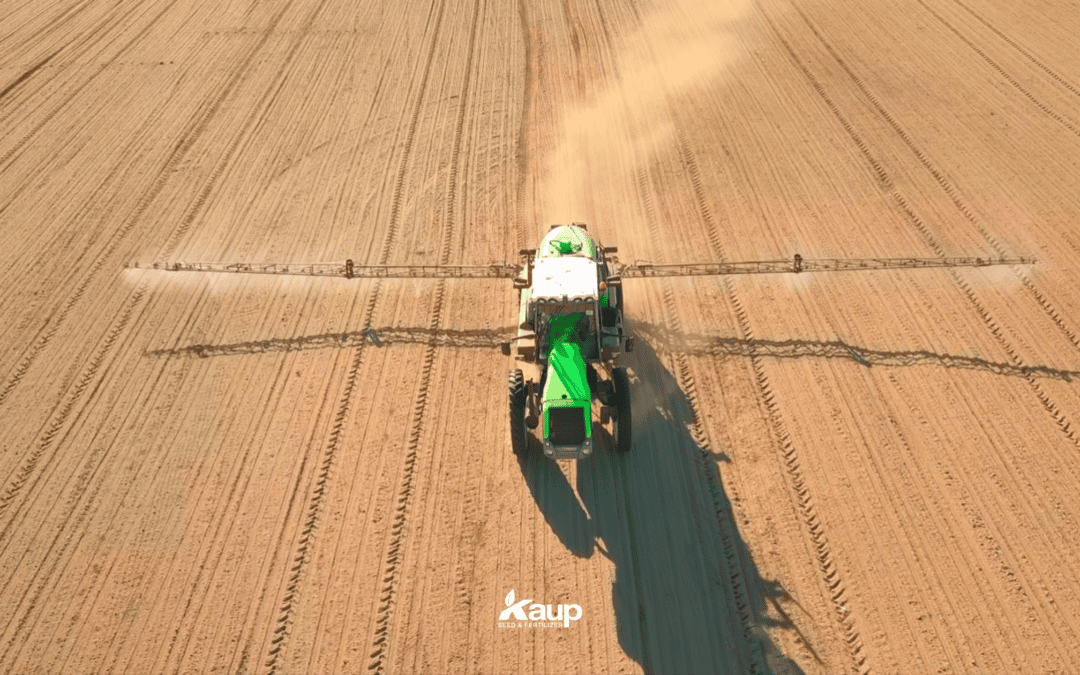
Kaup’s custom application service handles fall burndown, and booking early is the difference between an agronomically correct application and whatever slot happens to open up in mid November when the weeds have already stalled.
This is a phone call, not a field operation. It costs you ten minutes now and it protects the entire window.
If you have not already, this also pairs naturally with getting your soil sampling scheduled, which we covered in the August finish-line checklist. Both fill up on the same timeline for the same reason.
The Bottom Line
Weeds that survive the fall become next year’s biggest and cheapest-to-prevent headache.
Marestail is resistant to the chemistry most growers reach for first. Henbit sets seed within two weeks of flowering and feeds soybean cyst nematode all winter. Field pennycress does the same. All three are small, hidden, and killable right now, and all three are tough, seeded, and expensive by April.
You do not need to treat every acre. You need to walk your fields, find the ones that gave you trouble last spring, and get those on the schedule before the window closes.
Kick back the residue. See what is under there. Then make the call.
Not sure which of your fields earn a fall pass?
The answer depends on what is actually germinating out there right now, what your spring burndown did or did not accomplish last year, and where you have marestail resistance or nematode pressure building.
We have walked enough fall fields across Cuming, Dodge, Colfax, Stanton, Burt, Thurston, and Wayne counties to know which ones pay for the pass and which ones can wait. And we can get you on the application calendar before it fills.
Talk to a local expert today.