
Introduction
By the time your Cuming County corn is tasseling and your soybeans are flowering, timing aerial fungicide applications becomes the most consequential crop protection decision left in the season. You’ve invested in seed, fertility, herbicide programs, and starter. You’ve managed moisture and scouted for pests. Everything you’ve built from planting is sitting in the field right now — and one well-timed aerial pass can protect it or one delayed decision can cost it.
Here’s the reality that most growers don’t add up until after harvest: the aerial application itself carries a fixed cost per acre before a single product goes in the tank. Whether you’re running a Hagie sprayer, a fixed-wing airplane, or a helicopter, that cost is the same regardless of what you put in.
The difference between a good pass and a great pass isn’t the application cost. It’s what’s in the tank.
This guide covers every product Kaup recommends for corn and soybean protection — what each one is, where Kaup ranks it, what it actually does for your crop, and how to build a tank mix that earns back a multiple of what the pass costs.
Because one pass can do three jobs at once. But only if it’s built right.
Understanding the Tier System
Not all fungicides are created equal. Kaup organizes its fungicide recommendations into three tiers — Top, Mid, and Low and understanding what separates them tells you exactly when each tier earns its cost and when it doesn’t.
What Separates the Tiers
The difference between tiers comes down to three things: modes of action (MOA), active ingredient quality, and residual length.
Modes of action are the most important factor. Each MOA attacks fungal pathogens in a different way. Products with more MOAs:
- Control a broader spectrum of diseases
- Slow resistance development (pathogens can’t develop resistance to three mechanisms at once)
- Provide longer residual protection
The MOA groups that matter for corn and soybeans:
- Group 3 (Triazole/DMI): Curative activity, stops existing infections
- Group 7 (SDHI): Long residual, plant health benefits, greening effects
- Group 11 (Strobilurin/QoI): Preventive activity, broad spectrum, fast uptake
Top-tier products combine all three. Mid-tier products combine two. Low-tier products use one or two older chemistries at lower performance levels.
Iowa State Extension (2024) confirmed in multi-location soybean trials: Veltyma, Affiance, and Revytek delivered significantly less frogeye leaf spot severity compared to Priaxor and Aproach Prima. The tier structure isn’t marketing it reflects real performance data.
The Resistance Management Reality
Using the same single or dual MOA product year after year accelerates resistance development. Crop Protection Network (2024) confirms that rotating MOAs and using three-MOA products are the most effective resistance management strategies available.
In Cuming County, where southern rust and tar spot have both been active in recent seasons, resistance management isn’t theoretical it’s a real-season concern that affects next year’s options.
Top Tier Fungicides – The Performance Products
These are the products Kaup recommends when disease pressure is present, yield potential is high, and the ROI math supports the investment.
Veltyma – The Corn Standard
Manufacturer: BASF Crops: Corn only Rate: 7 oz/acre Active Ingredients: Mefentrifluconazole (Revysol) + Pyraclostrobin MOA: Groups 3 + 11
Veltyma’s defining characteristic is its active ingredient Revysol, the first and only isopropanol azole. Its unique molecular structure binds target enzymes more powerfully than conventional Group 3 products, which translates to broader disease spectrum, faster curative activity, and longer residual.
Veltyma fungicide has outperformed other corn fungicides by an average of 7.0 bu/acre in over 1,200 head-to-head comparisons, winning 81% of those matchups. It’s also BASF’s designated #1 tar spot fungicide — critical for Cuming County given four consecutive years of significant southern rust and increasing tar spot pressure.
The application window advantage: Veltyma’s label opens two weeks earlier than many competing products, which gives Cuming County growers more scheduling flexibility around weather and equipment availability. In years when aerial slots are tight and weather windows are narrow, that two-week buffer matters.
When Veltyma earns its cost:
- Disease present or conditions favor rapid spread
- Cuming County is experiencing hot, humid weather patterns
- Corn is at V10-VT stage (primary protection window)
- High-yield Nora silt loam ground where 7 extra bushels per acre = significant ROI
When to consider an alternative: On lighter Thurman-Blendon soils with lower yield ceilings, the per-bushel ROI math tightens. Run the numbers with your Kaup agronomist before committing.
Revytek — The Soybean Standard
Manufacturer: BASF Crops: Soybeans only Rate: 8 oz/acre Active Ingredients: Mefentrifluconazole (Revysol) + Fluxapyroxad (Xemium) + Pyraclostrobin MOA: Groups 3, 7, 11
Where Veltyma owns corn, Revytek owns soybeans. Three modes of action — including the same Revysol active that drives Veltyma’s performance — plus Xemium (BASF’s SDHI chemistry), making it the most comprehensive soybean fungicide Kaup carries.
Revytek wins 86% of head-to-head soybean comparisons and is the #1 grower-recommended soybean fungicide, trusted by soybean yield world record holders.
Application timing for soybeans: R3 (beginning pod stage) is the primary window. Iowa State Extension (2025) confirms soybeans are most responsive to fungicide protection between R3 and R5 — the same window where disease can cause the greatest yield loss. Ground sprayers can still access soybeans at R3 before canopy fully closes.
When Revytek earns its cost:
- Frogeye leaf spot, white mold, or sudden death syndrome history in the field
- Warm, humid conditions during pod fill
- High-yield soybean acres where pod retention matters
- Fields where disease scouting shows active infection on lower leaves
Delaro Complete — The Dual-Crop Solution
Manufacturer: Bayer Crops: Both corn and soybeans Rate: 8 oz/acre Active Ingredients: Prothioconazole + Trifloxystrobin + Fluopyram MOA: Groups 3, 7, 11
Delaro Complete is the only top-tier product Kaup recommends that is labeled for both corn and soybeans at the same rate. For operations running corn and soybeans in mixed fields, or for aerial application programs covering both crops in the same pass, this simplifies logistics significantly — one product, one rate, both crops.
In the 2024 Bayer University Corn Small Plot Trials, Delaro Complete applied at 8 oz/acre at R1 outperformed Veltyma at 7 oz/acre by at least 4 bu/acre. In soybeans, a dual R1+R3 application outpaced competing products by 4 bu/acre while managing white mold under varying pressure.
The SDHI chemistry (Fluopyram) drives greening effects that help crops handle stress and stay productive longer — which also supports standability and stalk integrity through grain fill.
When Delaro Complete earns its cost:
- Mixed corn/soybean acres in the same application window
- High tar spot pressure (Delaro Complete performed comparably to leading competitors in uniform fungicide trials)
- When resistance management across both crops is a priority
- When one product covering both simplifies the program
The honest performance picture: Veltyma wins more head-to-head corn comparisons in BASF trials. Revytek leads soybeans in BASF data. But Delaro Complete’s 2024 Bayer trial data shows it outperforming both in specific head-to-head matchups. The answer to “which is best” is season and pressure dependent — which is why your Kaup agronomist makes the final call based on what’s happening in Cuming County fields right now.
Delaro (325 SC) — Entry-Level Top Tier
Manufacturer: Bayer Crops: Both corn and soybeans Rate: 8 oz/acre Active Ingredients: Prothioconazole + Trifloxystrobin MOA: Groups 3 + 11
Delaro without the “Complete” designation is the two-MOA predecessor to Delaro Complete. It lacks the Fluopyram SDHI (Group 7) component. Still a solid performer with dual modes of action and broad-spectrum residual, but in most disease scenarios where top-tier protection is warranted, the upgrade to Delaro Complete is worth the additional cost per acre for the third mode of action.
Mid Tier Fungicides — The Right Tool at the Right Time
Mid-tier products aren’t compromises. They’re the right answer in specific situations — lower disease pressure, tighter budgets, sequential programs, or when used as tank-mix additions to build three MOAs from two-MOA base products.
Affiance — Kaup’s Early Application Product
Manufacturer: Gowan Company Crops: Both corn and soybeans Rate: 10 oz/acre Active Ingredients: Tetraconazole + Azoxystrobin MOA: Groups 3 + 11
Affiance is Kaup’s recommended V5 early-season application. It provides good early coverage at a mid-tier price point — but its residual doesn’t extend through the critical VT window in corn. This is why Kaup’s program pairs it with Veltyma or Delaro Complete at V10-VT: the Affiance protects the plant during early canopy development, then the top-tier product takes over for the reproductive stage.
Gowan Company notes Affiance delivers an average yield boost of 11 bu/acre in corn and 4 bu/acre in soybeans in their trial data — stronger than the mid-tier average. Gowan specifically recommends it for early application before a top-tier VT pass, with Affiance at R1 in soybeans followed by a second application 10-14 days later.
When Affiance makes sense:
- V5 early application before a top-tier VT pass
- Fields with documented early-season disease history
- Sequential programs where two passes are planned
Aproach Prima
Manufacturer: Corteva Crops: Both corn and soybeans Rate: 6.8 oz/acre Active Ingredients: Picoxystrobin + Cyproconazole MOA: Groups 3 + 11
Broad-spectrum mid-tier performer. Solid residual activity from both active ingredients. A reliable option when disease pressure is moderate and a top-tier investment isn’t justified by yield potential or field history.
Headline AMP
Manufacturer: BASF Crops: Both corn and soybeans Rate: 10 oz/acre Active Ingredients: Pyraclostrobin + Metconazole MOA: Groups 7 + 11
Headline AMP is BASF’s mid-tier sequential program fungicide — well-suited as a pre-tassel pass in corn when you want to protect the lower canopy before the top-tier VT application. BASF specifically recommends it in a pre-tassel/VT sequential program: Priaxor or Headline AMP pre-tassel, then Veltyma at VT-R2.
The sequential program logic: Pre-tassel application protects lower canopy from early disease establishment. VT application protects the ear leaf and upper canopy during grain fill. Two-pass programs in high-pressure or high-yield fields consistently outperform single-pass programs.
Priaxor
Manufacturer: BASF Crops: Both corn and soybeans Rate: 4 oz/acre Active Ingredients: Fluxapyroxad (Xemium) + Pyraclostrobin (F500/Headline) MOA: Groups 7 + 11
Priaxor is BASF’s longest-lasting residual mid-tier product. The Xemium SDHI chemistry continuously distributes through leaf tissue to deliver extended protection. At 4 oz/acre, the per-acre cost is manageable despite the per-gallon price.
The three-MOA upgrade: Priaxor + generic propiconazole (a cheap Group 3 triazole) = three modes of action at mid-tier total cost. This is a common efficiency play when the full top-tier price point isn’t justified but resistance management is still a priority.
Odyssey
Manufacturer: Helena Agri-Enterprises Crops: Both corn and soybeans Rate: 2.25 pt/acre Active Ingredients: Tebuconazole + Azoxystrobin + Potassium Phosphite MOA: Groups 3, 11 + phosphonate
Odyssey stands apart from other mid-tier options Kaup carries — the addition of potassium phosphite gives it a fourth mode of action that also activates the plant’s own natural defense mechanisms. Phosphite chemistry doesn’t just control disease from the outside; it triggers systemic acquired resistance inside the plant.
When the phosphite component adds value: Fields with a history of difficult-to-control diseases, or seasons where conditions favor rapid disease development. The plant defense activation provides a layer of protection that conventional fungicide chemistry alone doesn’t deliver.
Lucento
Manufacturer: FMC Crops: Both corn and soybeans Rate: 5 oz/acre Active Ingredients: Bixafen + Flutriafol (FMC-patented) MOA: Groups 3 + 7
Lucento is the only mid-tier product Kaup recommends with no strobilurin (Group 11) chemistry. This is a feature, not a limitation. Strobilurin chemistry is well-documented for causing green stem syndrome in soybeans — plants that stay green long after grain fill is complete, creating harvest delays and potential quality issues. Lucento avoids this entirely.
The Flutriafol triazole in Lucento is one of the most systemic on the market, and the Bixafen SDHI provides excellent residual. For growers who prioritize clean harvest timing on soybeans, or in fields where harvest windows are tight, Lucento is the right call.
Low Tier Fungicides — When Budget Rules
Low-tier products serve a role — they’re not useless, they’re situation-specific. The right situation for a low-tier fungicide is typically: low disease pressure, lower yield potential fields, or budget-constrained seasons where some protection is better than none.
A-Frame Plus
Manufacturer: Syngenta Crops: Both corn and soybeans Rate: 10 oz/acre Active Ingredients: Azoxystrobin + Propiconazole MOA: Groups 3 + 11
Part of Syngenta’s Plant Performance™ product line. Generic equivalent chemistry to Quilt Xcel. Two modes of action, broad spectrum, budget price. The entry point for disease protection when ROI math on mid or top-tier doesn’t pencil.
Generic Tilt (Propiconazole)
Manufacturer: Syngenta (Tilt is Syngenta’s branded propiconazole; “Generic Tilt” = generic propiconazole) Crops: Soybeans only (in Kaup’s program) Rate: 4 oz/acre Active Ingredient: Propiconazole MOA: Group 3 only
The most economical fungicide option in Kaup’s program. Single mode of action, no strobilurin component. Most useful as a tank-mix addition to build a second MOA into a program, or in very low pressure situations where minimal protection is needed. Not recommended as a standalone primary fungicide on high-yield ground.
RustEase
Manufacturer: WinField United Crops: Both corn and soybeans Rate: 5 oz/acre Active Ingredients: Azoxystrobin + Cyproconazole MOA: Groups 3 + 11
Broad-spectrum preventive fungicide with both preventive and curative activity. Originally developed for soybean rust control — the name reflects its focus. Two modes of action with decent residual. A step up from Generic Tilt with the added strobilurin component.
Xylem Plus
Manufacturer: AgriDNA3 (independent brand) Crops: Both corn and soybeans (in Kaup’s program) Rate: 24 oz/acre Active Ingredient: Potassium phosphite (56% active ingredient concentration) MOA: Phosphonate (no FRAC group number — phosphite chemistry)
Xylem Plus is its own independent product — not a generic of anything. It’s EPA-labeled as both a fungicide and bactericide, which is unusual. The phosphite chemistry is entirely different from strobilurins or triazoles — it works preventatively and curatively by activating the plant’s own systemic acquired resistance while also directly inhibiting pathogens. No disease resistance documented after prolonged use, and pH neutral for tank mixing. Up to 60 days of protection at label rates.
Insecticides — When the Tank Mix Gets a Third Job
The aerial pass doesn’t have to be fungicide-only. Adding an insecticide to the tank mix is where the pass goes from two jobs to three — disease control, plant health, and pest protection — with zero additional application cost.
The decision to add an insecticide should be based on active scouting, not calendar date. Here’s how Kaup ranks its insecticide options and when each makes sense in the tank:
Hero – The Premium Broad-Spectrum Option
Manufacturer: FMC Crops: Both corn and soybeans Rate: 5 oz/acre Active Ingredients: Bifenthrin + Zeta-cypermethrin MOA: Pyrethroids (two different chemistries)
Hero is Kaup’s premium insecticide recommendation for broad-spectrum pest control. The combination of bifenthrin and zeta-cypermethrin delivers fast knockdown plus long residual across 45 labeled insects in corn and soybeans. The dual-pyrethroid formulation is patented — it’s not just two generics mixed together.
Best application in the aerial tank mix for corn: silk-feeding beetles (corn rootworm adults, Japanese beetles) at R1 when population thresholds are met. Hero applies just before silking to protect the silk window.
Best application for soybeans: soybean aphids above 250 per plant with populations increasing, or defoliating insects (Japanese beetle, bean leaf beetle) above threshold before R6.
Steward EC — The Caterpillar Specialist
Manufacturer: FMC Crops: Both corn and soybeans Rate: 8 oz/acre Active Ingredient: Indoxacarb MOA: Group 22A (voltage-dependent sodium channel blocker)
Steward’s unique mode of action makes it the go-to when caterpillar pests are the primary target — true armyworm, fall armyworm, corn earworm. Group 22A is completely different from pyrethroid chemistry, which means no cross-resistance with products like Generic Brigade or Generic Warrior.
The bee toxicity advantage: Indoxacarb is significantly less toxic to bees than pyrethroids. For aerial applications over flowering soybeans, Steward is the more pollinator-friendly insecticide choice when caterpillar control is needed.
Mustang Maxx
Manufacturer: FMC Crops: Both corn and soybeans Rate: 4 oz/acre Active Ingredient: Zeta-cypermethrin MOA: Pyrethroid
Fast knockdown pyrethroid, same active as one of the two components in Hero but without the bifenthrin residual. Good choice when you need quick knockdown on a visible pest population without the cost of the full Hero premix.
Generic Brigade (Bifenthrin)
Manufacturer: Various (Brigade is FMC’s brand — generic bifenthrin = generic version of Brigade) Crops: Both corn and soybeans Rate: 5 oz/acre Active Ingredient: Bifenthrin MOA: Pyrethroid
The budget alternative to Hero’s bifenthrin component. Good residual, broad spectrum, significantly lower cost than Hero. When the dual-active premium of Hero isn’t necessary for the pest you’re targeting, Generic Brigade delivers the residual piece at lower cost.
Generic Warrior (Lambda-cyhalothrin)
Manufacturer: Various (Warrior is Syngenta’s brand — generic lambda-cyhalothrin = generic version of Warrior) Crops: Both corn and soybeans Rate: 3.5 oz/acre Active Ingredient: Lambda-cyhalothrin MOA: Pyrethroid
Kaup’s most economical insecticide option. Fast knockdown, broad spectrum, no residual component. Best for situations where you need pest suppression right now and residual protection isn’t a priority.
Generic Pounce (Permethrin)
Manufacturer: Various (Pounce is FMC’s brand — generic permethrin = generic version of Pounce) Crops: Both corn and soybeans Rate: 4 oz/acre Active Ingredient: Permethrin MOA: Pyrethroid
Budget-tier pyrethroid. Older chemistry with decent activity on a range of insects. Lower cost than Hero or Mustang Maxx.
Generic Lorsban 4E (Chlorpyrifos)
Manufacturer: Various (Lorsban is Corteva’s brand — generic chlorpyrifos = generic version of Lorsban) Crops: Both corn and soybeans (in Kaup’s program) Rate: 0.75 pt/acre Active Ingredient: Chlorpyrifos MOA: Organophosphate
⚠️ Important label note: EPA amended chlorpyrifos labels in September 2024, limiting food crop uses to 11 specific crops effective July 2025. Corn is not among the 11 remaining approved uses. Before applying any chlorpyrifos product to corn acres, verify the current label status with your Kaup agronomist or your local extension office. Soybean use remains permitted under the current regulatory framework, but this is an active area of EPA review and labels should be confirmed each season. The label is the law — always verify before application.
The Tank-Mix Add-In That Costs Nothing Extra
Yield On — The Biostimulant That Rides Along
Manufacturer: Syngenta Biologicals Application: Added directly to the fungicide tank — never applied as a standalone
Yield On is the most efficient input on this list because it adds yield potential without adding an application pass. It goes in the fungicide tank — Veltyma, Revytek, or Delaro Complete — and is applied at the same time, in the same aircraft or sprayer, with no additional fuel, equipment time, or field passes.
What it does: stimulates the plant to move more nitrogen, sugar, and micronutrients into the developing grain during fill.
What it delivers:
- Corn average: 4 bu/acre additional yield
- Soybeans average: 1.5 bu/acre additional yield
The math on a 320-acre Cuming County operation running both crops:
Same pass, same flight, zero additional application cost — the yield On benefit is essentially pure margin added to an investment you’re already making:
- 160 corn acres × average 4 bu/ac = 640 additional bushels of corn
- 160 soybean acres × average 1.5 bu/ac = 240 additional bushels of soybeans
At current corn and soybean prices, that’s a meaningful return from a product that required no extra trips across the field. Talk to your Kaup agronomist about what that math looks like at your specific yield targets and local basis.
Adjuvants — What Keeps the Chemistry on the Plant
A note on Coron: Kaup includes Coron as part of its aerial program as a foliar liquid nitrogen/micronutrient product — not a fungicide or insecticide. It is often tank-mixed with the aerial fungicide pass as a foliar N boost during grain fill. Please confirm with your Kaup representative which specific Coron product applies to your program (US formulations include Helena’s Coron® 25-0-0 foliar nitrogen) before including in any tank mix, as formulations vary.
Masterlock
Spray adjuvant and sticker that improves adhesion and rainfastness. Getting chemistry to stay on the leaf surface matters — rain within hours of application can wash product off before absorption is complete. Masterlock reduces that risk at a modest per-acre cost.
Precisive
Drift reduction and deposition adjuvant. For aerial applications specifically, reducing drift is both a regulatory concern and an agronomic one — chemistry that drifts off-target doesn’t protect your crop. Precisive improves coverage and deposition at low carrier volumes, which is exactly the challenge with aerial application. A low per-acre cost that earns its place on every aerial pass.
Section 8: Building the Right Tank Mix
The Core Decision Framework
Step 1: Identify your primary disease threat
- Southern rust or tar spot active? → Veltyma (corn) or Revytek (soybeans)
- Moderate pressure, mixed disease spectrum? → Delaro Complete for both crops
- Low pressure, budget season? → A-Frame Plus or RustEase with Generic Tilt tank-mix
Step 2: Decide on insecticide add-in
Scout first. Add only if thresholds are met:
- Silk-feeding beetles at R1 → Hero
- Caterpillars (armyworm, earworm) → Steward EC
- General pest suppression needed → Generic Brigade or Generic Warrior
- No threshold met → no insecticide needed (save the cost)
Step 3: Add Yield On to every fungicide pass
This is a no-decision. Same pass, same cost, average 4 bu/acre corn and 1.5 bu/acre soybeans. It goes in every time.
Step 4: Add adjuvants
Aerial application at 10-12 gallons per acre always benefits from Masterlock and Precisive. The carrier volume is low — you need adhesion and reduced drift to get the chemistry where it needs to go.
The Cuming County ROI Reality
Scenario: 160 acres of prime Nora silt loam corn, VT/R1 timing
| Component | Rate | Protected Yield |
| Aerial application | — | Fixed cost per acre |
| Veltyma | 7 oz/ac | +7 bu/ac avg |
| Yield On | Tank mix | +4 bu/ac avg |
| Hero (if beetles present) | 5 oz/ac | Protects pollination |
| Masterlock | 4 oz | Improves adhesion |
| Precisive | 0.64 oz | Reduces drift |
| Total | +11 bu/ac avg |
At current corn prices, 11 protected bushels per acre across 160 acres represents significant value from a single pass. Talk to your Kaup agronomist to run the ROI math at your specific yield targets, current grain prices, and field conditions before booking your aerial slot.
Section 9: Application Method — Matching the Method to the Situation
| Method | Water Volume | Best For |
| Hagie Sprayer | 10-12 gal | V10-V12 corn, R3 soybeans (before canopy closure) |
| Fixed-Wing Airplane | 5-10 gal | Tasseled corn, large acreage, time-sensitive windows |
| Helicopter | 5-10 gal | Precision coverage, irregular field shapes, smaller acreage |
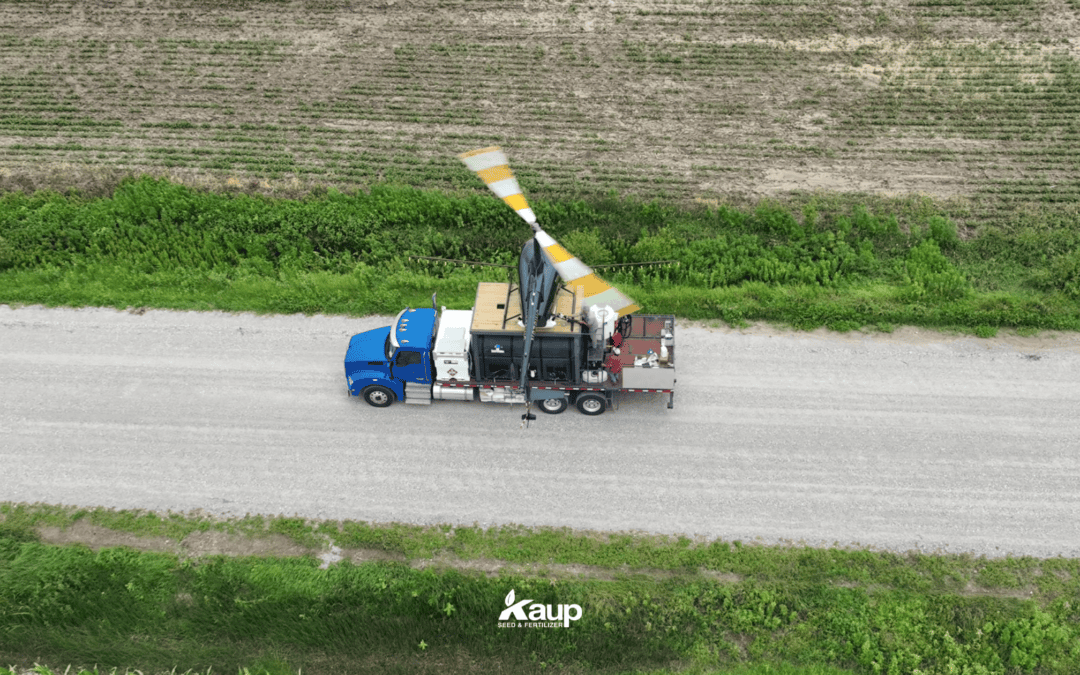
The key timing constraint: Once corn is fully tasseled at VT/R1, ground sprayers cannot pass through without breaking stalks. This is when aerial becomes the only practical option. Kaup’s aerial application service provides both fixed-wing and drone options — book slots before the tassel window arrives, not after.
Water volume matters for coverage: Aerial applications run 5-10 gallons per acre vs. 15-20 gallons for ground equipment. The lower carrier volume means adjuvants that improve deposition and coverage (Precisive, Masterlock) earn their cost on every aerial pass.
Conclusion
The aerial pass is the most concentrated investment decision of the growing season. The application cost is fixed whether your tank contains the right products or the wrong ones. What changes is what comes out the other side at harvest.
For Cuming County corn: Veltyma at VT/R1 is the performance standard, backed by 1,200+ head-to-head comparisons. For soybeans: Revytek at R3 leads grower-reported results and wins 86% of head-to-head comparisons. When both crops need coverage from one product: Delaro Complete covers both. Add Yield On to every fungicide pass — same pass, same flight, extra bushels at zero extra cost.
Scout for insects before the pass. Add an insecticide to the tank only when thresholds justify it. Use adjuvants on every aerial application. Verify the Lorsban 4E label status before applying to any crop this season.
The operations across Cuming County pulling 220+ bushels out of their best ground aren’t guessing at tank mixes. They’re building them intentionally — product by product, pass by pass, with the ROI math verified before the aerial slot is booked.
One pass. Built right. Maximum protection.
Call to Action
Not sure which fungicide tier is right for your fields this season?
The right tank mix depends on what’s actually happening in Cuming County right now — disease pressure, weather forecast, field history, and yield potential by soil type. What works on Nora silt loam ground may not be the same decision on Thurman-Blendon acres.
Whether you’re dialing in fungicide product selection, deciding whether to add an insecticide to the tank, or booking your aerial application slot before the VT window arrives, we’ve built tank mixes across Cuming County long enough to know what the data says and what the fields actually show.
Talk to a local expert today.