
Quick Reference:
The Frustration Peak
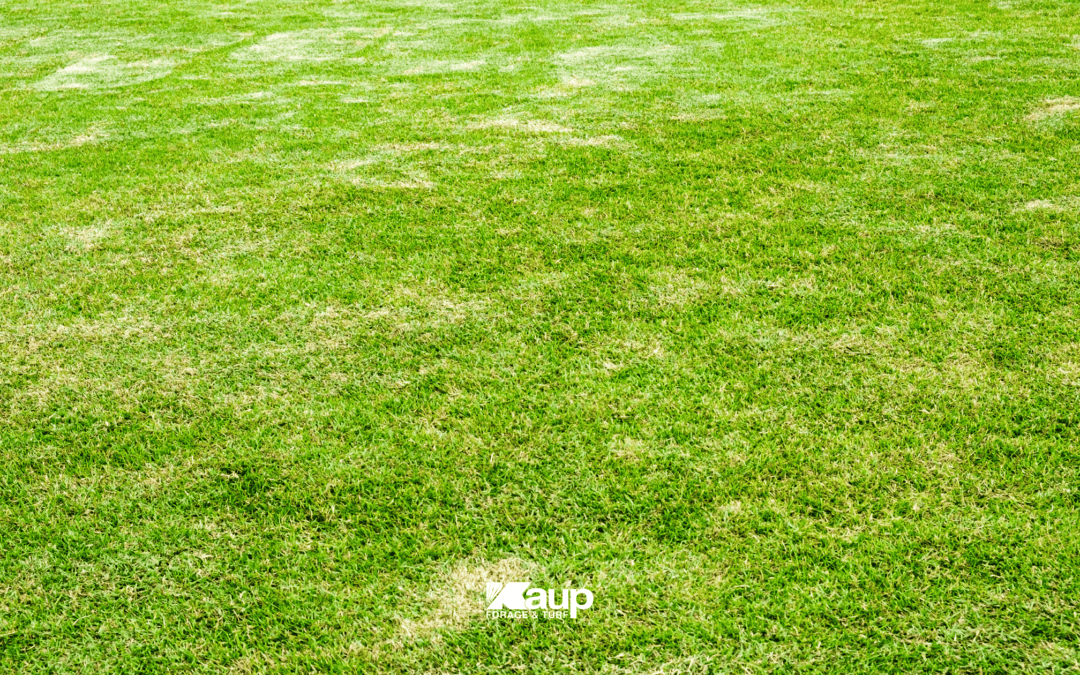
July brings a specific kind of lawn anxiety. You walk outside, see brown patches, thin spots, or discoloration that wasn’t there in June, and your first thought is usually: What’s wrong with my lawn?
Your second thought based on years of hearing lawn care warnings is often worse: Is it grubs? Fungus? Have I killed it?
Here’s what nobody tells homeowners: summer lawn stress doesn’t mean lawn failure. Many of the problems you see in July—browning, slow growth, thin areas, weak color—are seasonal responses to heat and humidity, not signs that something catastrophic is happening. Your lawn isn’t necessarily dying. It might just be going dormant, stressed but alive, waiting for cooler weather to resume growth.
But some July lawn problems are serious: grub tunneling that will kill sections come fall, fungal infections that spread and weaken the stand, or traffic damage during heat stress that creates permanent thin spots. The challenge is distinguishing between “this looks bad but will recover in fall” and “this needs action now.”
This guide explains the most common July lawn problems, how to tell whether you’re dealing with temporary stress or permanent damage, and—most importantly—what actually helps and what makes things worse.
Section 1: The Most Common Summer Lawn Stressors
Grubs: The Underground Threat
White grubs are the larval stage of Japanese beetles, masked chafers, and similar beetles. Grubs live in soil, eating grass roots. A healthy population of a few grubs per square foot causes no visible damage. But heavy infestations (10+ grubs per square foot) can destroy sections of lawn, pulling up like carpet because the roots are gone.
Why July matters for grubs:
Grubs hatch in early summer and spend June-September eating roots. Peak damage is visible in late July through September when grubs are largest and eating most aggressively. However, the preventive window to stop grubs is June (with preventive grub control products).
Signs of grub damage:
- Irregularly shaped dead patches that appear in full sun, in high-traffic areas, or near pavement where soil is warm
- Spongy turf that pulls up easily like carpet—the roots are severed, so the sod separates from soil with minimal resistance
- Increased animal activity — skunks, raccoons, moles digging in lawn searching for grubs (this damage is often mistaken for the grubs themselves)
- Brown patches concentrated in late summer (August-September) after warm, wet conditions in June-July
The diagnostic test:
Cut out a 12-inch square of suspect turf and flip it back. Count white C-shaped grubs in the soil. 1-3 grubs = acceptable. 5+ grubs = treatment may be warranted. 10+ = significant infestation requiring action.
Important: Seeing grub damage in July means the grubs hatched in June. Preventive grub control products need to be applied in May-June to stop them before they hatch. If you’re seeing damage now, preventive products won’t help this year—you’re choosing between tolerating the damage or using curative products (with mixed effectiveness). Plan preventive applications for next May.
Fungal Disease: Heat + Humidity = Infection
Several fungal diseases thrive in Nebraska’s July-August conditions: brown patch (most common), dollar spot, Pythium blight, and anthracnose. These diseases exploit heat-stressed grass, establishing quickly when conditions favor them.
Why July activates fungus:
Fungal diseases need three things: the pathogen (present in most soils), susceptible host (heat-stressed grass), and environmental trigger (high humidity, wet grass, warm nights). July in Nebraska hits all three.
Signs of fungal disease:
Brown patch (most common in July):
- Circular patches, 2-12 inches in diameter initially (can expand rapidly)
- Smoke-gray or dark outer ring; tan/light center
- Often creates a “doughnut” pattern (dark ring, dead center, green middle)
- Spreads in concentric circles as fungus moves outward
Dollar spot:
- Dime-to-quarter-sized circular patches
- Tan/straw color with reddish-brown border
- Often coalescent (many patches connecting)
- More common in fine-textured grasses (fine fescue, bentgrass)
Pythium blight (rare but devastating):
- Greasy-looking dark streaks or patches
- Extremely rapid spread (can destroy significant area in 24-48 hours)
- Occurs during hot, humid, wet conditions
- Often along contours where water collects
The key distinction: Fungal diseases have defined edges, specific color patterns, and often concentric or circular shapes. Heat or drought stress usually causes irregular browning across broader areas, without sharp borders or distinct color rings.
Treatment window: Fungicides are most effective as preventive applications (applied before disease appears). If the disease is already visible, some curative products can slow its spread, but they’re less effective than prevention. Once symptoms are obvious, the fungus is established.
Heat Stress: The Metabolic Crisis
Heat stress isn’t a disease—it’s a physiological response to conditions outside the grass’s optimal range. Cool-season grasses thrive at 60-75°F; they stress at 85°F+ and begin to struggle under extreme temperatures.
What happens during heat stress:
When air and soil temperatures soar, the grass’s metabolism goes into overdrive. The plant burns energy faster than it can create it. Photosynthesis becomes less efficient. Growth stops. The plant enters a survival mode that looks like damage but isn’t permanent.
Signs of heat stress (not disease or grubs):
- Uniform or diffuse browning across sunny areas (not circular patches like fungus or separated sod like grubs)
- Loss of color — grass turns gray-green, then tan/straw color
- Blue-gray appearance in the morning when dew is present (sign of dehydration)
- Slow growth — mower isn’t collecting much despite adequate watering
- Leaf rolling — grass blades curl to minimize surface area and moisture loss
- Increased weed pressure — as grass growth slows, weeds outcompete in weak spots
Heat stress is different from dormancy. Heat-stressed grass stays alive but grows very slowly. True dormancy (though rare in Nebraska in summer) means top growth dies back completely but crowns remain alive.
Section 2: Signs of Stress vs. Permanent Damage
The critical question: Is what you’re seeing temporary summer stress that will recover in fall, or permanent damage requiring action now?
Temporary Heat/Drought Stress (Will Recover)
Visual signs:
- Whole lawn is lighter colored, but grass blades are still present
- Brown color is uniform across sunny areas, not concentrated in irregular patches
- Lawn still has density; you can see mostly green if you look closely
- No separation of sod from soil (when you step on it, it springs back with effort)
- Footprints linger but don’t remain permanently visible
Why it recovers: Cool-season grass crowns survive summer stress. Once fall temperatures drop (mid-September), the grass exits survival mode and resumes growth. Fall rainfall and cooler nights trigger vigorous green-up. By October, heat-stressed lawns that had adequate root depth look nearly normal again.
What to do:
- Water appropriately (1-1.5 inches per week)
- Don’t apply summer fertilizer (forces growth the plant can’t support)
- Maintain higher mowing height (3.5-4 inches)
- Don’t overshoot damage—it’s not permanent
- Plan fall renovation to thicken any thinned areas
Recovery timeline: 4-6 weeks of fall growth (September-October) returns most heat-stressed but structurally sound lawns to acceptable appearance.
Permanent Damage Requiring Action
Visual signs:
- Bare soil showing — not just thin grass, but actual soil exposure
- Sod pulls up easily — roots are severed (grub sign) or fungus has killed the plant
- Distinct patches with clear borders — especially circular (fungus) or irregular but concentrated (grub tunneling or disease)
- Persistent dead spots that don’t green up even with watering
- Weed invasion in specific areas — weeds establishing where turf was killed, not just where grass slowed down
- Mold or slime visible on soil surface or on grass blades (possible fungal fruiting bodies or Pythium damage)
Why it doesn’t recover without intervention: Dead roots mean no plant there. Fungal-killed crowns won’t regrow. Bare soil in July will be bare soil in August and September. Weeds will establish and then compete when you try to overseed in the fall.
What to do now:
- Get a diagnosis (bring a sample to your local Kaup dealer)
- Treat if it’s grubs (curative products available but inconsistently effective)
- Treat if it’s active fungal disease (some curative fungicides work on dollar spot; brown patch is harder to stop once established)
- Stop making it worse (don’t mow lower, don’t add fertilizer, don’t overwater)
- Plan fall repair (aeration, overseeding, possible sod replacement for large dead areas)
Recovery timeline: Fall overseeding fills small damaged areas (2-3 weeks of growth shows new seedlings). Larger dead spots may require sod installation or may need 2-3 fall seeding cycles to fully thicken.
Section 3: What Actually Helps Lawns Recover
If you’re looking at temporary summer stress, recovery happens naturally. If you’re looking at permanent damage, most recovery work happens in fall. What actually helps in July is managing expectations and planning ahead.
Proper Expectations: July is Survival Mode
Stop thinking “I need to fix my lawn in July.” Start thinking “I need to protect my lawn through July so I can fix it in September.”
July lawn goals:
- Keep crowns alive (adequate water, not excessive)
- Prevent additional stress (avoid mowing during heat waves, minimize foot traffic)
- Prevent new problems (treat visible fungus promptly; preventive grub control would have happened in June)
- Maintain basic function (the lawn still provides ground cover even if it’s not pretty)
This is fundamentally different from spring goals (building the lawn) or fall goals (renovating the lawn). Summer is about holding the line, not improving.
What doesn’t help in July:
- Summer fertilization — forces growth the plant can’t support, increases water demand, increases disease risk
- Fungicide after disease is established — preventive applications (June) work; curative applications (after July symptoms appear) are inconsistently effective
- Scalping or aggressive mowing — removes the photosynthetic tissue the plant needs to generate energy, exposes crowns to sun
- Daily watering — trains roots to stay shallow, increases disease risk, wastes water
- Trying to break dormancy — if the lawn has gone semi-dormant, forcing it to grow out of dormancy depletes reserves without benefit
- Intensive aeration or overseeding — stress on top of stress; wait for fall when grass can recover
What does help in July:
- Adequate deep watering (1-1.5 inches per week to 6-inch depth)
- Proper mowing height (3.5-4 inches, leaving clippings)
- Sharp mower blades (clean cuts, not stress-inducing shredding)
- Prompt disease diagnosis and treatment if fungus is identified (curative products work better on some diseases than others, but starting early helps)
- Grub monitoring (count them; decide if treatment is warranted for significant infestations)
- Limiting additional stress (staying off the lawn during peak heat, avoiding heavy traffic)
Fall Planning: Where Recovery Actually Happens
July struggles are solved in September. Here’s why planning matters now:
Late August-September is peak renovation season for cool-season grass. This is when:
- Soil temps are warm enough for seed germination (60-70°F)
- Air temps are cool enough for grass growth (60-75°F)
- Rainfall typically increases (natural moisture for establishment)
- The grass is actively growing and can recover quickly
Planning in July means:
- Aeration booked for mid-to-late August (so soil is prepared when seeds go down in early September)
- Overseeding seed selected and on-hand (right variety for your sun/shade situation)
- Fall fertilizer ordered (higher phosphorus for root development, lower nitrogen than spring)
- Weed control planned (broadleaf weeds are most susceptible to herbicide in fall after they’ve stored reserves in roots)
Waiting until September to book aeration means waiting through August when contractors are backed up. Waiting to order seed means limited selection. Waiting to think about fall means scrambling rather than planning.
Your local Kaup dealer can help you:
- Assess what’s temporary stress and what’s permanent damage
- Select the right overseeding mix for your lawn’s sun/shade/traffic conditions
- Plan fall aeration timing
- Choose fall fertilizer and weed control products
- Develop a realistic timeline for fall recovery
Wrap-Up: July is About Protecting, Not Fixing
The lawn you’re worried about in July—with brown patches, thin areas, weak color—is probably not in crisis. It’s stressed, but heat stress is temporary. Fall recovery is coming.
The actual damage that needs action—grub tunneling that will spread, fungal infection that will kill sections, traffic damage during dormancy that creates permanent thin spots—these are the things worth diagnosing and addressing. But even these are best fixed in fall with proper renovation, not patched over in July heat.
July lawn care is about:
- ✅ Watering appropriately
- ✅ Mowing at proper height
- ✅ Identifying actual problems (fungus, grubs) versus seasonal stress
- ✅ Planning fall renovation
- ❌ NOT forcing growth through fertilization
- ❌ NOT trying to perfect a summer lawn in peak heat
- ❌ NOT treating symptoms without diagnosis
Your best lawn-building month of the year is September. July is just getting there.
Connect With Your Local Kaup Dealer for Summer Lawn Diagnosis
If you’re seeing brown patches, thinning areas, or other July lawn stress and you’re not sure if it’s heat, grubs, fungus, or something else, bring a sample to your local Kaup dealer.
A quick diagnosis—and honest “this will recover on its own” or “this needs action”—saves time, money, and stress.
Contact Kaup today to discuss:
- Grub monitoring and prevention strategy (plan for next June)
- Fungal disease identification and treatment
- Fall renovation planning (aeration, overseeding, fertilization)
- Summer watering and mowing best practices
- Realistic expectations for July lawn appearance
Explore Kaup lawn solutions:
- Kaup Turf Grass – Quality varieties for fall renovation
- Kaup Turf Mixes – Specialized seed blends for sun, shade, repair
- Kaup Fertilizer, Chemicals & Care – Fall fertilizer, fungicides, grub control
July looks rough. September recovery starts now with proper diagnosis and fall planning. Let Kaup help you get there.
This guide provides information for Nebraska homeowners managing summer lawn stress. Always diagnose problems before treating. Consult with your local Kaup dealer for site-specific advice and product recommendations.